روضة RawdahLibrary of How to Muslim
  1. Rawdah
  2. The Heart
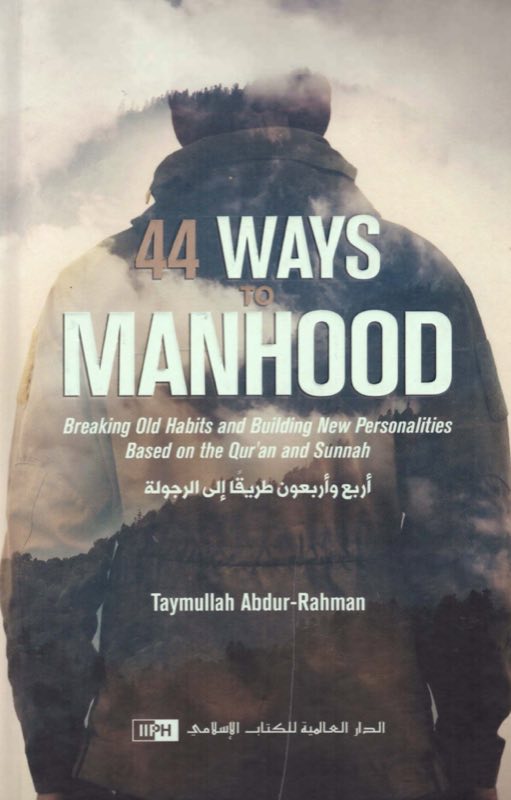
  3. 44 Ways to Manhood
Cover of 44 Ways to Manhood by Taymullah Abdur-Rahman: a man seen from behind, with mountains and clouds blended into his jacket

Our reading notes · Gardens of the Heart and Fiqh

44 Ways to Manhood

by Taymullah Abdur-Rahman · International Islamic Publishing House, 2018

A short, direct book for Muslim men by an imam who has served as a prison chaplain and as a university imam. It sets out 11 essentials, from sincerity and halal income to a home, clean habits and good manners, then 33 suggestions, from memorising a line of Qur’an a week to keeping promises, honouring women and fasting three days a month. Its aim is strength with gentleness, not harshness. Below are our notes on each of the 44, one step from each to take on, what to read with care, and links to the guide, Prophetic Footsteps and our other sites.

Publisher
IIPH, Riyadh, 2018
Ways
11 essentials, 33 suggestions
Length
128 pages
Good for
Young men, new Muslims, fathers

These notes are written in our own words; the book’s text isn’t reproduced here. Its hadith are mostly sound and the publisher gives grades for many, but a few are weak or credited to the wrong collection, and a few fiqh statements are stricter than the four schools. We list them under “Read with care”. For the same 44 as a weekly checklist for everyone, men and women, see the Blueprint on Ummah Atlas.

الرجولة

The shape of the book

Eleven essentials and thirty-three suggestions

The book first lays down eleven essentials a man needs in place, then gives thirty-three shorter suggestions. We number all 44 in order (way 12 is suggestion 1) and have grouped the suggestions by theme to make them easier to find.

الفصول

Chapter notes

The 44 ways, in brief

Pick a way for what the book says about it, the points worth remembering, anything to read with care, and the pages to go deeper with on the guide, Prophetic Footsteps and our other sites.

  1. 1Sincerity to Allah
  2. 2Knowing Allah
  3. 3Consistent Worship
  4. 4Halal Provision
  5. 5A Righteous Wife
  6. 6Righteous Children
  7. 7A Comfortable Home
  8. 8Good Hygiene
  9. 9Excellent Manners
  10. 10Dependable Transport
  11. 11Basic Understanding of Fiqh
  12. 12A Line of Qur’an a Week
  13. 13Get in Shape
  14. 14Go Easy on Unhealthy Food
  15. 15Grow Your Beard
  16. 16Be Tolerant
  17. 17Tell the Truth
  18. 18Keep Promises, Repay Debts
  19. 19Be Brave
  20. 20Keep a Secret
  21. 21Be Serious and Dignified
  22. 22Be Shy Before Allah
  23. 23Volunteer
  24. 24Don’t Be Loud
  25. 25Practise Arabic Reading and Writing
  26. 26Don’t Side with Oppression
  27. 27Honour Women
  28. 28Do Every Task Excellently
  29. 29Give Charity in Secret
  30. 30Leave Foul Speech
  31. 31Treat People Equally
  32. 32Save for Emergencies
  33. 33Talk to Your Lord
  34. 34Pray in Congregation
  35. 35Respect Leadership
  36. 36Be a Good Guest and a Good Host
  37. 37Take Care of Your Family
  38. 38Give Gifts
  39. 39Mind Mixed-Gender Interaction
  40. 40Cry Before Allah
  41. 41Fast
  42. 42Never Backbite, or Let It Happen
  43. 43Stay Quiet, and Don’t Brag
  44. 44Avoid Excess Luxury

Way 1

Sincerity to Allah

Essential 1 of 11 · Faith first

The first essential: whatever a man does, he does it for Allah. Every other way in the book rests on this one.

Key points

  • The religion is sincere counsel: to Allah, His Book, His Messenger ﷺ, the leaders and the people (Muslim). The author reads it as being true in every effort, from worship to advising others.
  • Actions are judged by intentions (al-Bukhari), so a deed done for anyone but Allah carries no reward.
  • A deed is accepted when three things meet: the doer is Muslim, it follows the Sunnah, and it is done for Allah alone.
  • The test of sincerity is not only praying but staying away from what Allah forbids: many people pray, fewer leave their bad habits.
  • Sincerity protects what a man leaves behind: in al-Kahf (18:82) the wall is rebuilt for two orphans because their father was righteous.

Think aboutThink of one thing you do mostly to be seen. Could you do it for Allah instead, or quietly?

Write a fa’idah from this chapter

Way 2

Knowing Allah

Essential 2 of 11 · Faith first

Knowledge of tawhid starts in books but only lasts through action: knowing why we worship, not just how.

Key points

  • Saying the shahadah is the start, not the finish: tawhid means knowing what Allah commands and forbids and living by it every day.
  • Shaykh al-‘Uthaymin warned that many people know the hows of Islam without the whys, which leaves their faith exposed when money, love or the mind are under strain.
  • Al-Fatihah holds the three parts of tawhid: His Lordship (1:2), His names and attributes (1:3), and that He alone is worshipped and asked for help (1:5).
  • The book follows the approach of affirming the names and attributes Allah gives Himself, as the Qur’an states them, without picturing them or explaining them away.
  • Knowing Allah softens the heart and puts a short life in perspective; not knowing Him leads to confusion, then disobedience.

Think aboutPick one name of Allah you say often. What does it change about how you live this week?

Write a fa’idah from this chapter

Way 3

Consistent Worship

Essential 3 of 11 · Faith first

Remaining firm on the right course (41:30) is worship kept up over years, guarded by the prayer and good company.

Key points

  • Ease can make a man careless: the book traces how small allowances, an old friend or a wandering eye, slide into a life of hiding and lying.
  • The first deed a servant is asked about on the Day of Resurrection is his prayer (at-Tirmidhi 413; sahih, Darussalam).
  • Choose friends the way you choose fruit: look at their speech, their private lives and where they are heading, because that is where you are heading too.
  • Praying five times a day washes a man like bathing in a river at his door five times (al-Bukhari, Muslim).
  • A man who prays on Friday and drinks on Saturday has not understood where his strength comes from.

Think aboutWho are the three people you spend most time with? Are they pulling your prayer up or down?

Write a fa’idah from this chapter

Way 4

Halal Provision

Essential 4 of 11 · Provision and home

A man must never treat haram income as an option, even when money is tight. A little earned honestly beats a fortune earned badly.

Key points

  • The believers are told to eat from the good things Allah provides and to be grateful (2:172), and not to make lawful or unlawful what He has not (10:59).
  • A man should be ready to run a business and to sweep the floor, to earn millions and to work for pennies.
  • The man who travels far, dusty and dishevelled, raising his hands to Allah, is not answered while his food, drink and clothing are haram (Muslim).
  • Being grateful for what you have closes the door Shaytan uses to push people towards haram to feed their wants.

Read with care

  • The forty days of a haram mouthful. The narration that a single haram mouthful keeps a man’s deeds from being accepted for forty days (at-Tabarani, al-Awsat 6495) has a weak chain in the judgment of hadith scholars across the centuries: at-Tabarani noted that only one narrator carries it, al-Mundhiri judged it too weak even to be called hasan, ad-Dimyati called its chain unsound, Ibn Rajab said it needs scrutiny, al-Haythami found narrators in it he could not identify, and al-Albani graded it very weak. Ibn Baz added that its meaning has support in other reports. The publisher’s note says the book carries no weak hadith. The sound hadith on haram income and du‘a is the dusty traveller in Muslim (1015).

Think aboutIs there anything in how you earn or spend that you would not want examined? What would fixing it cost?

Write a fa’idah from this chapter

Way 5

A Righteous Wife

Essential 5 of 11 · Provision and home

Marriage is the foundation of family and community, and the right wife is a man’s greatest support in this world and towards the next.

Key points

  • The Prophet ﷺ told young men who can afford it to marry, as it guards the eyes and chastity (al-Bukhari, Muslim).
  • Marriage teaches a man what he lacks: a single man can sleep anywhere and eat anything; a husband has to provide, learn and teach.
  • Piety in a wife does not mean being uneducated or passive; it means a woman whose worship and character benefit her family.
  • At Hudaybiyah, when the Companions hesitated, Umm Salamah advised the Prophet ﷺ to act first in silence, and they followed (al-Bukhari): the best advice may be beside you.
  • Khadijah, Fatimah, Asiyah and Maryam are the four best women of Paradise (Ahmad; graded sahih by al-Hakim, Ibn Hibban, Ahmad Shakir and al-Albani), each a model of support, patience or faith.

Read with care

  • Hudaybiyah was an ‘umrah. The book says the Prophet ﷺ set out for Hajj in the sixth year. He and the Companions set out for ‘umrah; it was that ‘umrah the Treaty of Hudaybiyah turned back (al-Bukhari 2731).
  • Who asked whom he loved most. The book has “the Companions” asking. It was ‘Amr ibn al-‘As who asked, and the answer went on: among men, her father, then ‘Umar (al-Bukhari 3662).
  • Is marriage obligatory?. The book calls marriage obligatory in general on every man who can afford it. The four schools generally hold it strongly recommended for a man who can afford it, and obligatory when he fears falling into zina without it.

Think aboutIf you are married, when did you last ask your wife’s advice and act on it? If not, what are you looking for?

Write a fa’idah from this chapter

Way 6

Righteous Children

Essential 6 of 11 · Provision and home

Righteous children are raised, not just fed and clothed: through play, teaching, friendship and constant du‘a.

Key points

  • Teach manners early, but let children be children: those given no room to play tend to take their freedom later, when you can no longer guide them.
  • A common saying (not a hadith) divides it into play until seven, teaching until fourteen, then friendship.
  • Give daughters love and attention early, and privacy and patience as they grow up.
  • Asked how he raised his children, a respected shaykh simply looked up and raised his hands: he made du‘a for them constantly.
  • A righteous child who prays for you is one of three things that keep benefiting you after death (Muslim).

Think aboutHow often do you pray for your children by name? Add it to one prayer a day.

Write a fa’idah from this chapter

Way 7

A Comfortable Home

Essential 7 of 11 · Provision and home

A home is where a man rests from the world. Spaciousness is a blessing to work towards, without letting comfort take over the heart.

Key points

  • Allah made our homes a place of rest (16:80), and a spacious home is named among the things that bring happiness (Ibn Hibban, in his Sahih; al-Mundhiri, al-Arna’ut and al-Albani accept its chain).
  • Allah is beautiful and loves beauty (Muslim): wanting good clothes and a decent home is not pride.
  • Real asceticism is holding the world in your hand, not in your heart.
  • Room to breathe helps a marriage cool down after an argument, and gives children space to play safely at home.
  • A man is not judged by the size of his house, but he cannot use the decree as an excuse not to try to provide.

Read with care

  • The du‘a for a spacious home. The du‘a asking forgiveness, a spacious home and blessed provision is in at-Tirmidhi (3500), where its chain is graded weak. The hadith naming a spacious home among the things that bring happiness is sound: Ibn Hibban included it in his Sahih, and al-Mundhiri, al-Arna’ut and al-Albani accept its chain.

Think aboutWhat one change would make your home more restful for the people in it?

Write a fa’idah from this chapter

Way 8

Good Hygiene

Essential 8 of 11 · Bearing and understanding

Purification is half of faith (Muslim). Being clean, groomed and pleasant to stand next to is part of a man’s religion.

Key points

  • Your body has a right over you (al-Bukhari), and the five acts of the fitrah cover the basics of grooming (al-Bukhari, Muslim).
  • The Prophet ﷺ cared so much about clean teeth that he would have ordered the siwak at every prayer, had it not been hard on people (al-Bukhari).
  • Whoever has eaten garlic or onion should stay away from the masjid (al-Bukhari): if a permitted smell keeps you home, think about smelling of smoke.
  • Allah accepts no prayer without purification (Muslim), and neglecting cleanliness costs a man work, trust and respect.
  • Untidiness is not piety: the Prophet ﷺ was simple and humble, and clean, combed and well dressed.

Read with care

  • The man with uncombed hair. The report of the Prophet ﷺ sending a man to tidy his hair and beard (Malik) is mursal, a chain with a missing link, as the book itself notes. The point stands on sound hadith such as the five acts of the fitrah and the siwak.

Think aboutAsk someone you trust: is there anything about how you look or smell that people would not tell you?

Write a fa’idah from this chapter

Way 9

Excellent Manners

Essential 9 of 11 · Bearing and understanding

Nothing is heavier on the Scale than good character (at-Tirmidhi 2002; sahih, Darussalam). Knowledge without manners is a tree without fruit.

Key points

  • The best of you are those with the best character (al-Bukhari); kindness is owed to everyone, not only to Muslims of your own group.
  • Asma’ was told to keep good ties with her mother who had not accepted Islam (al-Bukhari).
  • Abu Jahl was famed for intelligence yet rejected the truth; Bilal had no status in Makkah and was raised by his faith and character.
  • The Prophet ﷺ repeated himself three times so he was understood, and greeted people at night quietly so sleepers were not woken (al-Bukhari, Muslim).
  • Good character can bring a believer to the rank of those who pray at night and fast by day.

Read with care

  • Two hadith that are not in al-Bukhari. The book gives two hadith on good character to al-Bukhari. Good character bringing a believer to the rank of one who prays at night and fasts by day is in Abu Dawud (4798; al-Mundhiri accepted its chain, Ibn Hajar called it hasan, and al-Arna’ut and al-Albani graded it sahih). Taqwa and good character as what most brings people into Paradise is in at-Tirmidhi (2004, sahih).
  • Abu Jahl’s name. The book says his original name was Abu Hakm. His name was ‘Amr ibn Hisham; Abu al-Hakam was his kunya, and the Muslims called him Abu Jahl.

Think aboutWho in your life gets your worst manners? Start with them.

Write a fa’idah from this chapter

Way 10

Dependable Transport

Essential 10 of 11 · Bearing and understanding

Being able to get yourself and your family where you need to go is part of carrying responsibility, though the book’s editor notes this depends on where you live.

Key points

  • Riding animals and ships are among Allah’s favours, and the Qur’an gives the words to say when we mount them (43:12–13).
  • A sound narration names a good wife, a spacious home and a compliant mount among the elements of happiness (al-Hakim, who graded its chain sahih; al-Mundhiri accepted it and al-Albani graded it hasan).
  • A reliable car lets a man reach work, the masjid and the hospital on time, and do favours for others.
  • Strong and sturdy, not flashy, should be the aim.

Think aboutWho could you offer a lift to this week: to the masjid, a hospital, or a job interview?

Write a fa’idah from this chapter

Way 11

Basic Understanding of Fiqh

Essential 11 of 11 · Bearing and understanding

A little fiqh teaches humility: many differences between Muslims are permitted ones, and laymen should not be labelling others over them.

Key points

  • Matters of creed and matters of fiqh are different. Calling on the dead is not a matter of opinion; where you place your hands in prayer is.
  • The four schools differ on many details of wudu and salah, and deriving rulings needs a mujtahid, not a reader of isolated narrations.
  • The word quru’ in 2:228 can mean menstruation or purity, and the schools reach different rulings on the waiting period from it.
  • Some carry knowledge without understanding it, and pass it to those who understand it better (Ibn Majah 230; hasan, Darussalam).
  • Asked about his hands in prayer by a neighbour who had watched him closely, the author asked when the man had found time to worship.

Think aboutIs there a practice you have judged someone for that turns out to be a valid opinion?

Write a fa’idah from this chapter

Way 12

A Line of Qur’an a Week

Suggestion 1 of 33 · Worship and the Qur’an

The first suggestion and the door to all the rest: memorise at least one line a week, in Arabic and in your own language.

Key points

  • Revelation began with the command to read in the name of your Lord (96:1).
  • Even men who have been Muslim for decades often know only the last three short surahs, and recite them badly.
  • Learn each line with a qualified reciter who can correct you, and know what it means.
  • One line a week is about fifty a year: small, steady and possible for anyone.

Think aboutWhich line will you learn this week, and who will check your recitation?

Write a fa’idah from this chapter

Way 13

Get in Shape

Suggestion 2 of 33 · Body and appearance

Health and free time are two blessings most people waste (al-Bukhari). A man should look after his body as well as his mind.

Key points

  • The strong believer is better and more beloved to Allah than the weak, and there is good in both (Muslim).
  • Earlier generations kept fit by walking, farming and travel; desk jobs mean we have to plan for it.
  • The book suggests something as simple as fifty push-ups or a ten-minute jog a day.
  • Do not grow your learning while neglecting your strength.

Think aboutWhat could you do for ten minutes a day, starting tomorrow?

Write a fa’idah from this chapter

Way 14

Go Easy on Unhealthy Food

Suggestion 3 of 33 · Body and appearance

Eat from the good things, without excess (20:81). The Prophet ﷺ loved sweet things, but they were honey and natural foods.

Key points

  • Poor food catches up with every man as he ages.
  • ‘Umar is reported to have avoided luxurious food and clothes for fear of lessening his reward in the next life.
  • Moderation is the point, not banning enjoyment.

Think aboutWhich food habit would you be embarrassed to explain to a doctor? Swap one thing.

Write a fa’idah from this chapter

Way 15

Grow Your Beard

Suggestion 4 of 33 · Body and appearance

The book counts the beard as part of a Muslim man’s identity and treats shaving it as a sin it urges readers to leave.

Key points

  • The schools differ on how long or full it should be; grow what Allah gives you, even if it is thin.
  • The author pushes back on “it’s only a sunnah”: following the Sunnah is following the Prophet ﷺ (3:31), and he told us to hold to his way and that of the rightly guided caliphs (at-Tirmidhi 2676; sahih, Darussalam).
  • Do not let others’ opinions shake your confidence in your Muslim identity.

Read with care

  • The schools on shaving the beard. The book says none of the four schools allows shaving it. The Hanafi, Maliki and Hanbali schools hold it forbidden; in the Shafi‘i school the relied-upon position is that it is strongly disliked, though some Shafi‘i scholars held it forbidden.

Think aboutIs there a Sunnah you have dropped because of what others think? What would keeping it look like?

Write a fa’idah from this chapter

Way 16

Be Tolerant

Suggestion 5 of 33 · Courage and fairness

Zeal for the religion must not turn a man into a bigot. He was sent as a mercy, not to curse people (Muslim; 21:107).

Key points

  • A believer is someone people feel safe around, with their lives and their property.
  • He is not a believer whose neighbour is not safe from him (al-Bukhari): the street, the town and the country you live in are your neighbours.
  • The Prophet ﷺ stood for a passing funeral, and when told it was a Jew’s, said: was he not a soul? (al-Bukhari, Muslim).
  • Being patient with other faiths does not water down your own.

Read with care

  • “A believer is one others feel safe with”. The book gives this to al-Bukhari. The wording is at-Tirmidhi (2627) and an-Nasa’i (4995), both sahih: the believer is the one people trust with their lives and wealth. Al-Bukhari (10) has the related hadith that a Muslim is one from whose tongue and hand others are safe.

Think aboutWho in your street or workplace would feel safer, or more welcome, if you made the first move?

Write a fa’idah from this chapter

Way 17

Tell the Truth

Suggestion 6 of 33 · Word and trust

Always. Lying is for those who fear what the truth will bring, and a lie about something small soon becomes a lie about everything.

Key points

  • Fear Allah and speak words that are right and just (33:70).
  • Men who lie to win praise, a deal or a woman think they are clever; it is the mark of a boy, not a man.
  • Exaggerated stories about yourself are lies too.

Think aboutWhat is the small lie you tell most often? Catch it once this week.

Write a fa’idah from this chapter

Way 18

Keep Promises, Repay Debts

Suggestion 7 of 33 · Word and trust

Fulfil your contracts (5:1). Do not promise what you cannot do, and treat every debt as a trust.

Key points

  • Write loans down with witnesses, as the Qur’an teaches (2:282), and repay on time.
  • If you cannot pay on the date, say so and ask for more time; hiding from the person you owe only makes it worse.
  • The same goes for appointments: be there, or call ahead to cancel.

Read with care

  • The witnesses to a debt. The book says two male witnesses. The verse of debt (2:282) asks for two men, or one man and two women.

Think aboutIs there a debt or promise you have been avoiding? Contact that person this week.

Write a fa’idah from this chapter

Way 19

Be Brave

Suggestion 8 of 33 · Courage and fairness

Bravery is standing up for what is right without fear of blame, never being the aggressor, and never being a coward.

Key points

  • Fleeing does not save you from death (33:16); some principles matter more than life.
  • Courage means putting yourself in harm’s way for justice, not harming others.
  • Obey the law and never take matters into your own hands; bravery is not recklessness.
  • Live with taqwa and put your trust in Allah at every step.

Think aboutWhere have you kept quiet out of fear when you should have spoken up?

Write a fa’idah from this chapter

Way 20

Keep a Secret

Suggestion 9 of 33 · Word and trust

If someone asks you not to tell, do not tell. The exception: anyone who confesses they have harmed, or will harm, others.

Key points

  • Plans to harm innocent people are not a secret to keep: telling your imam and the authorities is a duty.
  • Whoever covers a Muslim’s faults, Allah will cover his on the Day of Resurrection (al-Bukhari).
  • Talebearing grows when people are bored with worship, and whoever carries tales to you will carry tales about you.
  • One of two men punished in the grave for something people think small used to carry tales to cause enmity (al-Bukhari).

Think aboutHas anyone trusted you with something you later shared? Is there anything to put right?

Write a fa’idah from this chapter

Way 21

Be Serious and Dignified

Suggestion 10 of 33 · Word and trust

Not a clown and not a grouch: laugh and smile, but keep control of your amusement.

Key points

  • Smiling and a gentle laugh were the Prophet’s ﷺ way; uncontrolled laughter and endless jokes are not.
  • The scholars the author sat with were serious without being stiff.
  • Most laughing in company is politeness, not real amusement; a man who jokes about everything is taken lightly.
  • Do not grab, wrestle or lift people in fun unless both of you want it and the setting is right.

Think aboutDo people take you seriously when it matters? What would change that?

Write a fa’idah from this chapter

Way 22

Be Shy Before Allah

Suggestion 11 of 33 · Worship and the Qur’an

Modesty is part of faith. Avoid images, films and places that displease Allah, and never be somewhere you would not want death to find you.

Key points

  • The angels who record our deeds are shy of sin; act so they greet you as friends at death (41:31).
  • A taste for explicit entertainment should fade as a man matures; Allah is patient with those who keep trying.
  • The hadith of the servant who sins, repents and returns gives hope to the sincere who struggle (Muslim), but it is not permission to sin.
  • It is better to be weak and admit a sin is a sin than to call it permissible.
  • If you have no shame, do as you wish (al-Bukhari).

Think aboutWhat do you watch or scroll past that you would not want an angel to record? Remove one source.

Write a fa’idah from this chapter

Way 23

Volunteer

Suggestion 12 of 33 · Giving and service

Nothing earns respect like serving people, Muslim and not, in any good effort.

Key points

  • Volunteering need not be a formal programme: clearing an elderly neighbour’s drive of snow counts.
  • The aim is to please Allah by improving your surroundings and serving people.
  • Not being able to give any good at all is its own loss.

Think aboutWhat one hour of help could you give this month, and to whom?

Write a fa’idah from this chapter

Way 24

Don’t Be Loud

Suggestion 13 of 33 · Word and trust

Never argue or shout. Speak calmly and politely even under pressure, and do not let anyone make you lose control.

Key points

  • Luqman told his son to lower his voice; the harshest of sounds is the braying of donkeys (31:19).
  • “Do not become angry” (al-Bukhari) means not acting on anger, since feeling it is human.
  • A man who loses his temper in a dispute has already lost it; interrupting and over-animation cheapen a man too.
  • Be quick to forgive and the first to apologise.

Think aboutWhen did you last raise your voice at home? What set it off?

Write a fa’idah from this chapter

Way 25

Practise Arabic Reading and Writing

Suggestion 14 of 33 · Worship and the Qur’an

Pace yourself, but do not neglect the language of the Qur’an. Even the first letters open a door.

Key points

  • Arabic unlocks meanings that translation cannot carry.
  • Without it you depend on someone else’s rendering of Allah’s words.
  • A man who advises others from the Qur’an should be able to read it.

Think aboutWhat could you learn in fifteen minutes a day: the letters, or a word from each ayah you pray with?

Write a fa’idah from this chapter

Way 26

Don’t Side with Oppression

Suggestion 15 of 33 · Courage and fairness

Do not defend your brother when he is wrong. Help him by telling him so.

Key points

  • Stand firm for Allah as witnesses to justice (5:8).
  • Help your brother whether he is the wronged or the wrongdoer: helping the wrongdoer means stopping him (al-Bukhari).
  • No friendship is worth abandoning the truth for.
  • If you always want backing whether you are right or wrong, and resent those who disagree, repent.

Think aboutIs there a friend whose wrong you have stayed quiet about? How could you advise them kindly?

Write a fa’idah from this chapter

Way 27

Honour Women

Suggestion 16 of 33 · Family and women

Be kind and affectionate with your wife, mother and daughters. Never harm them, physically or in any way.

Key points

  • The best of you are the best to their families, and the Prophet ﷺ was the best to his (at-Tirmidhi 3895; sahih, Darussalam).
  • The Prophet’s ﷺ wives and the Companions’ wives spoke their minds; a wife who is upset has the right to say so.
  • Do not demand a standard of character from her that you do not keep yourself: model it, encourage it, be patient.
  • Look past looks to character, and keep your wife’s private matters out of conversations with other men.
  • If you cannot solve a problem together, take it to older, wiser men, not young and emotional ones.

Read with care

  • The conversation of Adam and Hawwa’. The account of Hawwa’ telling Adam she was created so he could find rest in her comes from tafsir reports through as-Suddi, credited to Ibn ‘Abbas and Ibn Mas‘ud, not from a hadith of the Prophet ﷺ. What is in al-Bukhari (3331) is the command to treat women kindly, as woman was created from a rib.

Think aboutWhen did you last thank your mother, wife or daughter for something specific?

Write a fa’idah from this chapter

Way 28

Do Every Task Excellently

Suggestion 17 of 33 · Giving and service

Your work shows who you are. Whatever you agreed to do, do it fully and well.

Key points

  • Woe to those who take in full and give short (83:1–3): short-changing applies to work as much as to weights.
  • Sweeping a floor or cleaning a bathroom well is humility and gratitude, not beneath you.
  • The prophets all worked as shepherds at some point.

Think aboutWhich task do you always do half-heartedly? Do it properly once this week.

Write a fa’idah from this chapter

Way 29

Give Charity in Secret

Suggestion 18 of 33 · Giving and service

Wealth is purified by sharing it, and the best giving is so quiet the left hand does not know what the right gave.

Key points

  • Among the seven shaded on the Day of Judgement is the one who gives charity in secret (al-Bukhari).
  • Money held back from giving is not saved; it is lost.
  • Secret charity protects your sincerity from wanting praise.

Think aboutGive something this week that nobody will ever know about.

Write a fa’idah from this chapter

Way 30

Leave Foul Speech

Suggestion 19 of 33 · Word and trust

Do not curse or swear. Speak clearly and with dignity.

Key points

  • Crude slang has become fashionable, even in advertising, to the point that people are mocked for speaking properly.
  • Whoever imitates a people is one of them (Abu Dawud 4031; Ibn Taymiyyah called its chain good, Ibn Hajar hasan and al-‘Iraqi sahih, though al-Mundhiri and others weakened one of its narrators): speech shapes identity.
  • Clean speech is a choice to make every day, especially around the young.

Think aboutWhich word do you use that you would not want your children to repeat?

Write a fa’idah from this chapter

Way 31

Treat People Equally

Suggestion 20 of 33 · Courage and fairness

Greet everyone with the same warmth, the cleaner and the boss alike.

Key points

  • Spread the salam (Muslim), look at people when you greet them, and turn towards the one you are speaking to, as he ﷺ did.
  • Many men smile widely at the wealthy and mumble at the janitor; that is not justice.
  • Surah ‘Abasa (80:5–11) records the Prophet ﷺ being turned towards the blind man who came seeking.
  • With women, greet with modesty and respect; the book advises not shaking hands, as he ﷺ did not shake hands with women in the pledge (Ibn Majah 2874; sahih, Darussalam).

Think aboutWho do you walk past without greeting? Greet them first tomorrow.

Write a fa’idah from this chapter

Way 32

Save for Emergencies

Suggestion 21 of 33 · Giving and service

A funeral collection, a broken car, a brother in need: put a little aside each month for the first good cause that comes.

Key points

  • Spend from what Allah has provided (2:3), and save with the intention of giving.
  • Do not hoard; save enough for Hajj or your own funeral, whichever comes first.
  • A grown son is either an asset to his family or a weight on his mother and sisters.

Think aboutCould you set up a small monthly transfer into a “first cause” fund today?

Write a fa’idah from this chapter

Way 33

Talk to Your Lord

Suggestion 22 of 33 · Worship and the Qur’an

Remember Allah standing, sitting, lying down, alone and in company, and turn to Him first when problems come.

Key points

  • A man who stays away from the masjid because of his problems is avoiding the place where the answer is.
  • The Prophet ﷺ sought Allah’s forgiveness more than seventy times a day (al-Bukhari).
  • Dhikr after prayer is Sunnah, not innovation, and should not earn a man a label.
  • Hearts find rest in the remembrance of Allah (13:28).

Think aboutChoose a moment in your day, the commute or before sleep, to talk to Allah in your own words.

Write a fa’idah from this chapter

Way 34

Pray in Congregation

Suggestion 23 of 33 · Worship and the Qur’an

Prayer in congregation is twenty-seven times better than praying alone (al-Bukhari). If you can get to the masjid, go.

Key points

  • Do not hang around outside the masjid, or eat at its restaurant and leave when the adhan sounds.
  • Do not treat it as a social club, coming only when your friends are there.
  • Do not stay away because you dislike the imam.

Think aboutWhich prayer could you start praying at the masjid each day?

Write a fa’idah from this chapter

Way 35

Respect Leadership

Suggestion 24 of 33 · Courage and fairness

Respect your imam, your community, the law of the land and those in authority. Advise them privately, not publicly.

Key points

  • Criticising a leader is easy; rolling up your sleeves to help him and advise him sincerely is harder and nobler.
  • A saying goes that you can find seventy faults in a ruler, and a thousand in yourself if you took his place.
  • No one makes a good general who was not first a good soldier.
  • ‘Ali is reported to have said that his predecessors had followers like him, while he had followers like those around him.

Think aboutIs there a leader at your masjid or work you criticise but never help? Offer something.

Write a fa’idah from this chapter

Way 36

Be a Good Guest and a Good Host

Suggestion 25 of 33 · Giving and service

Accept invitations, invite good people, and behave well around food: people judge character at the table.

Key points

  • Whoever believes in Allah and the Last Day should honour his guest (al-Bukhari).
  • As a guest, do not stare at the house, wander through it or enter where you have not been invited.
  • You will be invited once by most people; good manners earn the second invitation.
  • Let only the God-fearing eat your food (Abu Dawud 4832 and at-Tirmidhi 2395, who graded it hasan; Ibn Hibban included it in his Sahih): host good company. What it meansThis is about the meals you choose to host: invitations, gatherings and hospitality. Al-Khattabi explained that it concerns the food of an invitation, not food given out of need (Ma‘alim as-Sunan), so it is no reason to hold back food from the poor, the hungry or the traveller. The Qur’an praises those who feed the needy, the orphan and the captive (76:8), and, as al-Khattabi points out, the captives of that time were not believers.Sharing a meal builds affection and closeness between hearts. When your guests are God-fearing, the strength they draw from your food goes into obeying and worshipping Allah, so you share in the reward, and they make sincere du‘a for their host.Feasting again and again with people who persist in disobedience can draw you into their ways, and spends your provision on heedlessness.

Think aboutWho could you invite to eat with your family this month?

Write a fa’idah from this chapter

Way 37

Take Care of Your Family

Suggestion 26 of 33 · Family and women

Do not spend every free hour with friends. Give your wife real time and play with your children.

Key points

  • The Prophet ﷺ raced ‘A’ishah (Abu Dawud 2578; Ibn Hibban included it in his Sahih, and al-Arna’ut and al-Albani graded it sahih) and took her to watch the sights.
  • Play with your family is one of the few pastimes not counted as wasted, with archery, training a horse and swimming (at-Tabarani; Ibn Hajar called its chain sound, and al-Albani graded it sahih).
  • A man who boasted he had never kissed his children was asked what could be done for him if Allah had taken mercy from his heart (al-Bukhari, Muslim).
  • Save the tough-guy act for outside; at home, be gentle.

Think aboutWhat could you do with your family this weekend that they would remember?

Write a fa’idah from this chapter

Way 38

Give Gifts

Suggestion 27 of 33 · Giving and service

Even a small gift, a pair of gloves or a pen, softens hearts and brings people closer.

Key points

  • Giving gifts builds love between people, as the Prophet ﷺ taught.
  • Give for Allah’s sake, as thanks for what He has given you.
  • The joy is in the giving, not the price.

Think aboutWho has not had a gift from you in a long time? Surprise them.

Write a fa’idah from this chapter

Way 39

Mind Mixed-Gender Interaction

Suggestion 28 of 33 · Family and women

Islam is balance, and its limits on contact between men and women protect both. The book urges care in mixing, for husbands as much as wives.

Key points

  • Many affairs begin with a spouse growing too close to a family friend.
  • Keep social settings separate as far as is reasonable, and speak to the other sex in a plain, businesslike way.
  • Lowering the gaze is commanded to believing men first (24:30), then to believing women (24:31).
  • Men must keep the same modesty they expect at home.

Think aboutIs there a friendship or conversation you would not want your spouse to read? Draw the line now.

Write a fa’idah from this chapter

Way 40

Cry Before Allah

Suggestion 29 of 33 · Worship and the Qur’an

Tears for Allah are a sign of a real man and awareness of Him. Let the Qur’an and funerals move you.

Key points

  • Among the seven shaded on the Day of Judgement is a man who remembered Allah alone and his eyes overflowed (al-Bukhari).
  • Skins shiver at the Qur’an, then hearts soften at His remembrance (39:23).
  • It is strange to attend a funeral in high spirits.

Think aboutWhen did you last weep in prayer? Try reciting slowly, alone, at night.

Write a fa’idah from this chapter

Way 41

Fast

Suggestion 30 of 33 · Worship and the Qur’an

Fast at least three days a month. It builds self-discipline and gratitude.

Key points

  • Fasting was prescribed so that we may gain taqwa (2:183).
  • Food has become a comfort that takes the place of thinking and reflection.
  • The son of Adam fills no vessel worse than his stomach (at-Tirmidhi 2380; sahih, Darussalam).

Think aboutWhich three days this month will you fast? Put them in your calendar now.

Write a fa’idah from this chapter

Way 42

Never Backbite, or Let It Happen

Suggestion 31 of 33 · Word and trust

Backbiting shows a fragile character: the one who does it is ignorant, and the one who listens is weak.

Key points

  • Verify news before acting on it, or you may harm people and regret it (49:6).
  • Reputations and lives have been ruined by gossip.
  • Keep away from known gossips, and keep conversations short with those who openly criticise others.
  • Do not just avoid it: stop it in your presence.

Think aboutNext time someone is backbitten in front of you, what will you say?

Write a fa’idah from this chapter

Way 43

Stay Quiet, and Don’t Brag

Suggestion 32 of 33 · Word and trust

Silence is dignity. Do not show off your possessions, your contacts or your children’s achievements.

Key points

  • Life in this world is play, show and boasting of wealth and children (57:20).
  • Long stories that are really about your furniture, your connections or your salary fool no one sensible.
  • Do not use the Qur’an like a club, or throw hadith into conversations that do not need them, to show your learning.
  • Showing off your children can expose them to the evil eye; protect them with the remembrance of Allah.

Think aboutWhat do you mention most often about yourself? Try a week without it.

Write a fa’idah from this chapter

Way 44

Avoid Excess Luxury

Suggestion 33 of 33 · Body and appearance

Do not eat, wear, drive or live in anything too luxurious. Live moderately by the standards of your time.

Key points

  • The wasteful are brothers of the devils (17:27).
  • Chasing fashion and the latest gadgets to fit in, or living well abroad while family back home go hungry, is not manhood.
  • After a simple meal of meat, dates and water, the Prophet ﷺ told Abu Bakr and ‘Umar they would be asked about that blessing (Muslim).
  • Moderation keeps a family from becoming spoiled and ungrateful.

Read with care

  • Asked about this blessing. The book places the hadith in al-Bukhari and has the Prophet ﷺ weeping. It is in Muslim (2038): after hunger brought him, Abu Bakr and ‘Umar out and an Ansari fed them, he said they would be asked about that blessing. The report does not mention weeping.

Think aboutWhat do you own or buy mostly to keep up with others? Skip it once.

Write a fa’idah from this chapter

العمل

Put it into practice

A way a day, and the du‘as

One small step from each of the 44 ways, to tick off as you go, and the du‘as the book mentions.

44 steps, one from each way

Take one a day, or start with the ones you need most. Tick them off as they become habits.

0 of 44 done

Your ticks are kept in this browser only.

  1. For Allah, not to be seen.

    Way 1: Sincerity to AllahThe purpose of life How to Muslim guide

  2. Then notice it during the day.

    Way 2: Knowing AllahThe 99 Names of Allah How to Muslim guide

  3. Where are they heading?

    Way 3: Consistent Worship

  4. Is it clean?

    Way 4: Halal ProvisionIslamic finance options How to Muslim guide

  5. Or, if unmarried, pray for a righteous spouse.

    Way 5: A Righteous Wife

  6. In one prayer every day.

    Way 6: Righteous ChildrenFamily life little Amanah

  7. A place of rest.

    Way 7: A Comfortable Home

  8. And use a siwak or brush before prayer.

    Way 8: Good HygieneHow to make wudu How to Muslim guide

  9. Starting at home.

    Way 9: Excellent MannersThe character of the Prophet ﷺ How to Muslim guide

  10. To the masjid, a clinic or an interview.

    Way 10: Dependable Transport

  11. Before you correct anyone.

    Way 11: Basic Understanding of FiqhWhy people pray differently The Open Door

  12. With its meaning, checked by a teacher.

    Way 12: A Line of Qur’an a WeekHow to memorise the Qur’an How to Muslim guide

  13. Push-ups, a jog or a brisk walk.

    Way 13: Get in Shape

  14. For honey, fruit or water.

    Way 14: Go Easy on Unhealthy Food

  15. With confidence.

    Way 15: Grow Your BeardHis daily Sunnah Prophetic Footsteps

  16. Of any faith.

    Way 16: Be Tolerant

  17. And replace it with the truth.

    Way 17: Tell the Truth

  18. Honestly and in good time.

    Way 18: Keep Promises, Repay Debts

  19. Calmly and lawfully.

    Way 19: Be Brave

  20. Unless someone is at risk of harm.

    Way 20: Keep a Secret

  21. Light-hearted, not silly.

    Way 21: Be Serious and Dignified

  22. An app, a channel or a habit.

    Way 22: Be Shy Before AllahI keep relapsing The Open Door

  23. Clear a neighbour’s path, help at the masjid.

    Way 23: VolunteerHow to give sadaqah How to Muslim guide

  24. And apologise first.

    Way 24: Don’t Be Loud

  25. The letters, or one word you pray with.

    Way 25: Practise Arabic Reading and WritingHow to learn Arabic How to Muslim guide

  26. Kindly, in private.

    Way 26: Don’t Side with Oppression

  27. For something specific.

    Way 27: Honour WomenWomen’s rights in Islam How to Muslim guide

  28. Without being asked twice.

    Way 28: Do Every Task Excellently

  29. Not even your left hand.

    Way 29: Give Charity in SecretHow to give sadaqah How to Muslim guide

  30. Start with the one you use most.

    Way 30: Leave Foul Speech

  31. The cleaner, the driver, the new face.

    Way 31: Treat People Equally

  32. For a funeral, a repair or a brother in need.

    Way 32: Save for Emergencies

  33. At a set moment each day.

    Way 33: Talk to Your LordIstighfar: du‘as for forgiveness How to Muslim guide

  34. Arrive before the iqamah.

    Way 34: Pray in CongregationHow to pray How to Muslim guide

  35. Instead of only criticising.

    Way 35: Respect Leadership

  36. And be a guest worth inviting back.

    Way 36: Be a Good Guest and a Good Host

  37. Play, race, talk.

    Way 37: Take Care of Your FamilyThe Prophet ﷺ and children little Amanah

  38. To someone who will not expect it.

    Way 38: Give Gifts

  39. Plain, polite and businesslike.

    Way 39: Mind Mixed-Gender Interaction

  40. Let the meaning reach you.

    Way 40: Cry Before AllahHow to pray tahajjud How to Muslim guide

  41. Put them in your calendar.

    Way 41: FastHow to fast How to Muslim guide

  42. Change the subject, or defend the absent.

    Way 42: Never Backbite, or Let It Happen

  43. Or your children’s.

    Way 43: Stay Quiet, and Don’t Brag

  44. Give the money instead.

    Way 44: Avoid Excess Luxury

Ummah Atlas turns the same 44 items into the Blueprint: a weekly checklist adapted for everyone, each with one checked verse or hadith and one action for the week.

Du‘as from the book

The meaning of each in our own words, with where it comes from. Learn the Arabic from a teacher or a trusted collection.

  • In every rak‘ah

    Guide us to the straight path.

    Qur’an 1:6Way 1

  • Ibrahim, for his children

    Keep me and my children away from worshipping idols.

    Qur’an 14:35Way 6

  • For forgiveness and a spacious home

    O Allah, forgive me my sin, give me room in my home, and bless what You have provided me.

    at-Tirmidhi (see Read with care)Way 7

  • When you set off on a ride

    Glory be to the One who made this serve us; we could never have done it ourselves.

    Qur’an 43:13Way 10

  • Seeking forgiveness

    I seek Allah’s forgiveness and turn to Him in repentance, as the Prophet ﷺ did more than seventy times a day.

    al-BukhariWay 33

More du‘as for every moment of the day are in the How to Muslim guide.

المزيد

Keep going

Read with care, then read on

A few narrations, details and rulings in the book that need care, and our sites that go deeper.

Details to read with care

The book is practical and well meant, but one narration it uses is very weak, two others are weak, several are credited to the wrong collection or person, one verse is misnumbered, and a few fiqh points are put more strictly than the schools put them. Here they are, way by way.

  • Essential 4

    The forty days of a haram mouthful

    The narration that a single haram mouthful keeps a man’s deeds from being accepted for forty days (at-Tabarani, al-Awsat 6495) has a weak chain in the judgment of hadith scholars across the centuries: at-Tabarani noted that only one narrator carries it, al-Mundhiri judged it too weak even to be called hasan, ad-Dimyati called its chain unsound, Ibn Rajab said it needs scrutiny, al-Haythami found narrators in it he could not identify, and al-Albani graded it very weak. Ibn Baz added that its meaning has support in other reports. The publisher’s note says the book carries no weak hadith. The sound hadith on haram income and du‘a is the dusty traveller in Muslim (1015).

    See our page
  • Essential 5

    Hudaybiyah was an ‘umrah

    The book says the Prophet ﷺ set out for Hajj in the sixth year. He and the Companions set out for ‘umrah; it was that ‘umrah the Treaty of Hudaybiyah turned back (al-Bukhari 2731).

    See our page
  • Essential 5

    Who asked whom he loved most

    The book has “the Companions” asking. It was ‘Amr ibn al-‘As who asked, and the answer went on: among men, her father, then ‘Umar (al-Bukhari 3662).

    See our page
  • Essential 5

    Is marriage obligatory?

    The book calls marriage obligatory in general on every man who can afford it. The four schools generally hold it strongly recommended for a man who can afford it, and obligatory when he fears falling into zina without it.

  • Essential 7

    The du‘a for a spacious home

    The du‘a asking forgiveness, a spacious home and blessed provision is in at-Tirmidhi (3500), where its chain is graded weak. The hadith naming a spacious home among the things that bring happiness is sound: Ibn Hibban included it in his Sahih, and al-Mundhiri, al-Arna’ut and al-Albani accept its chain.

  • Essential 8

    The man with uncombed hair

    The report of the Prophet ﷺ sending a man to tidy his hair and beard (Malik) is mursal, a chain with a missing link, as the book itself notes. The point stands on sound hadith such as the five acts of the fitrah and the siwak.

    See our page
  • Essential 9

    Two hadith that are not in al-Bukhari

    The book gives two hadith on good character to al-Bukhari. Good character bringing a believer to the rank of one who prays at night and fasts by day is in Abu Dawud (4798; al-Mundhiri accepted its chain, Ibn Hajar called it hasan, and al-Arna’ut and al-Albani graded it sahih). Taqwa and good character as what most brings people into Paradise is in at-Tirmidhi (2004, sahih).

    See our page
  • Essential 9

    Abu Jahl’s name

    The book says his original name was Abu Hakm. His name was ‘Amr ibn Hisham; Abu al-Hakam was his kunya, and the Muslims called him Abu Jahl.

  • Suggestion 4

    The schools on shaving the beard

    The book says none of the four schools allows shaving it. The Hanafi, Maliki and Hanbali schools hold it forbidden; in the Shafi‘i school the relied-upon position is that it is strongly disliked, though some Shafi‘i scholars held it forbidden.

  • Suggestion 5

    “A believer is one others feel safe with”

    The book gives this to al-Bukhari. The wording is at-Tirmidhi (2627) and an-Nasa’i (4995), both sahih: the believer is the one people trust with their lives and wealth. Al-Bukhari (10) has the related hadith that a Muslim is one from whose tongue and hand others are safe.

    See our page
  • Suggestion 7

    The witnesses to a debt

    The book says two male witnesses. The verse of debt (2:282) asks for two men, or one man and two women.

    See our page
  • Suggestion 16

    The conversation of Adam and Hawwa’

    The account of Hawwa’ telling Adam she was created so he could find rest in her comes from tafsir reports through as-Suddi, credited to Ibn ‘Abbas and Ibn Mas‘ud, not from a hadith of the Prophet ﷺ. What is in al-Bukhari (3331) is the command to treat women kindly, as woman was created from a rib.

    See our page
  • Introduction

    A verse reference

    The book closes its introduction with “this is the path of your Lord, straight” and cites al-An‘am 6:120. The verse is 6:126.

  • Suggestion 33

    Asked about this blessing

    The book places the hadith in al-Bukhari and has the Prophet ﷺ weeping. It is in Muslim (2038): after hunger brought him, Abu Bakr and ‘Umar out and an Ansari fed them, he said they would be asked about that blessing. The report does not mention weeping.

    See our page

فوائد

Your fawa’id

Write down what this book taught you

Each fa’idah is saved in your Rawdah notebook under 44 Ways to Manhood, with the chapter it came from. Your notebook page keeps them all, book by book.

Notes are kept in this browser only. Download a copy from your notebook page to keep them safe.

From this book0 notes

    Nothing yet. Your first fa’idah from this book will appear here.

    Open your whole notebook