روضة RawdahLibrary of How to Muslim
  1. Rawdah
  2. Fiqh
  3. Being Muslim
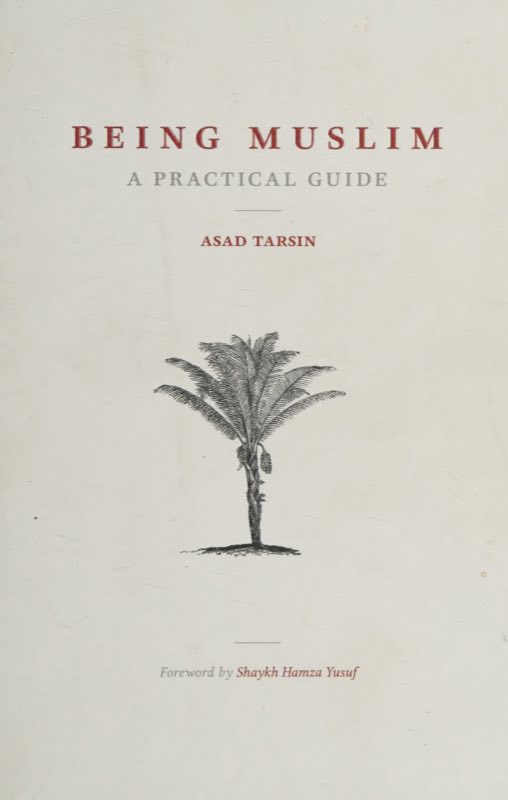
Cover of Being Muslim: A Practical Guide by Asad Tarsin

Our reading notes · Gardens of Belief, Fiqh and the Heart

Being Muslim

A Practical Guide · by Asad Tarsin · foreword by Hamza Yusuf

A manual for new and returning Muslims: what Muslims believe, how to pray, fast and give, how to grow inwardly, and how to live day to day. The author wrote it after a new convert asked him for a list of dos and don’ts, and realised beginners needed the basics in order instead. Below are our notes on each chapter, a first-steps checklist, the five prayers at a glance, the surahs the book suggests learning, and links to the pages on our own sites that go deeper.

Publisher
Sandala, 2015
Chapters
8, plus 2 appendices
Worship details
Maliki school
Good for
New and returning Muslims

These notes are written in our own words. The book’s text isn’t reproduced here, so read it in full in your own copy. Where a detail needs care, we say so under “Read with care”.

الدين

The shape of the book

Three dimensions of one religion

The book is built on the hadith of Jibril, in which the Prophet ﷺ explained islam, iman and ihsan. Each chapter serves one of them.

  • إسلام

    Islam Practice

    What the body does: the five pillars, the holy days and the law of daily life.

    3Worship7Islamic Holy Days8Lifestyle

  • إيمان

    Iman Belief

    What the mind affirms and the heart settles on: the six articles of faith.

    2Belief

  • إحسان

    Ihsan Excellence

    Worshipping Allah as though you see Him: the refinement of the heart.

    4Spiritual Refinement

Around all three. Where to begin, the Prophet ﷺ who taught the religion, and the Qur’an it rests on.

1Starting Point5The Prophet ﷺ6The Qur’an

الفصول

Chapter notes

Eight chapters, in brief

Pick a chapter for what it covers, the points worth remembering, any details to read with care, and where to go deeper on the guide, Ayah Unpacked, Prophetic Footsteps and our other sites. Page numbers are from the 2015 edition.

  1. 1Starting Point
  2. 2Belief
  3. 3Worship
  4. 4Spiritual Refinement
  5. 5The Prophet ﷺ
  6. 6The Qur’an
  7. 7Islamic Holy Days
  8. 8Lifestyle

Chapter 1

Starting Point

pp. 1–15

Sets you up for the road ahead: why pace matters more than speed, where Islam sits in the human story, and how knowledge of the religion reaches us through its scholars.

Key points

  • Check your intention before you begin, take things in gradually, and expect hard days as well as good ones.
  • Don’t overhaul your whole life in the first few months. Find good Muslim friends, and stay yourself: Islam refines who you are rather than replacing you.
  • Every soul affirmed Allah as its Lord before this life (7:172). Prophets came again and again to remind people of that covenant, ending with the Prophet Muhammad ﷺ.
  • The hadith of Jibril gives the religion three dimensions: islam, what the body does; iman, what the mind affirms; and ihsan, the state of the heart. Neglect one and the whole goes out of balance.
  • Arabic is the language of the prayer and of recitation. Du‘a, study and reading translations can be in any language.
  • Knowledge comes from the Qur’an and the Sunnah through qualified scholars. The four schools differ on details, not essentials, and that range of valid views is a mercy.

Think aboutOf the three dimensions, practice, belief and the heart, which gets the least of your attention right now?

Write a fa’idah from this chapter

Chapter 2

Belief

pp. 17–35

The six things a Muslim believes, beginning with the Shahadah, together with a short case for why belief in God is rational.

Key points

  • The Shahadah has two halves: denying every false object of worship and affirming Allah alone, then committing to live by that through following the Prophet ﷺ.
  • Tawhid means Allah has no partner, parts, equal or need. Shirk is the one sin not forgiven to someone who dies upon it.
  • Faith should rest on reason, not only on imitation. The chapter explains necessary, possible and impossible propositions, and why a universe with a beginning needs a cause.
  • Angels are made of light and never disobey. Jinn are made of fire and have free will, and Iblis refused to bow to Adam out of arrogance.
  • Four revealed books are named: the Torah, the Psalms, the Gospel and the Qur’an. Only the Qur’an has been kept unchanged.
  • Twenty-five prophets are named in the Qur’an, five of them the Messengers of Resolve. Muslims believe ‘Isa was not crucified and will return.
  • The questioning in the grave, the resurrection, the Scale and the Bridge are real. Decree and free will sit together: we answer for our choices, not for what befalls us.

Read with care

  • The names of the angels. The book calls Israfil “Raphael” and the Angel of Death “‘Izra’il”. Neither comes from the Qur’an or authentic hadith: the Qur’an calls him simply the Angel of Death (32:11), and matching Israfil with Raphael is a comparison from outside Islamic sources. Many scholars also read Raqib and ‘Atid (50:18) as descriptions, a watcher ever present, rather than names.
  • English names for some prophets. Pairing Dhul-Kifl with Ezekiel, Shu‘ayb with Jethro and Idris with Enoch is common in English books, but the Qur’an doesn’t make these links and scholars differ on them.

Think aboutThe chapter says we will be asked about how we responded to events, not about the events themselves. How does that change the way you look at a hard week?

Write a fa’idah from this chapter

Chapter 3

Worship

pp. 37–94

The longest chapter: the five rulings of Islamic law, then a practical walk through purification, prayer, zakah, fasting and Hajj, voluntary worship, and rulings particular to women.

Key points

  • Every act falls under one of five rulings: required, recommended, permitted, disliked or forbidden. Four of the five carry no sin, and a good deed is written ten times over.
  • Filth (najasah) is something physical you wash away. Ritual impurity is a state you lift with wudu or ghusl. Telling them apart settles many beginners’ worries.
  • It covers wudu, ghusl, the four conditions before prayer, each position of a rak‘ah and what to say in it, and the times and lengths of the five prayers.
  • A journey of about 48 miles lets you shorten the four-rak‘ah prayers to two, and join prayers while you are on the road.
  • Zakah is 2.5% of wealth held above the nisab for a full lunar year, given to eight kinds of recipient.
  • The fast runs from first light to sunset. The ill, travellers, pregnant and nursing women may break it and make it up, and guarding the eyes and tongue is as much a part of it as food.
  • Hajj joins sacred time, place and ritual, most of it following Ibrahim, Hajar and Isma‘il. Voluntary prayer, fasting, charity, du‘a and dhikr build on the pillars.

Read with care

  • Worship follows the Maliki school. The book says so, and its rulings are sound within that school. If your teacher or mosque follows another school you will meet differences: whether touching someone breaks wudu, whether a woman may recite the Qur’an during her period, whether eye drops break a fast, and the age of adulthood when no other sign appears (eighteen for the Malikis, fifteen for the Shafi‘is and Hanbalis). Follow one sound school consistently.
  • Seventy times, or seven hundred?. The book says the Qur’an promises seventy times the return on charity. The verse on this (2:261) pictures one grain growing seven ears of a hundred grains each, seven hundred, and adds that Allah multiplies further for whom He wills.
  • Deeds in Makkah. The hadith behind the figure of 100,000 is about prayer in al-Masjid al-Haram. Some scholars extended it to other deeds, and some to sins as well, while many held that a sin there is graver in weight rather than multiplied in number.

Think aboutAl-Ghazali’s six inner qualities of prayer are concentration, understanding, reverence, awe, hope and shame. Which one would change your next prayer the most?

Write a fa’idah from this chapter

Chapter 4

Spiritual Refinement

pp. 95–117

Ihsan in practice: what the inner self is made of, how vices are uprooted and virtues grown, and the character the Prophet ﷺ modelled.

Key points

  • We are born with a fitrah that leans towards the good, so Islam has no original sin. The ego (nafs) wants its appetites, reason is meant to lead it, and the heart is where they meet.
  • Refinement means finding the balanced middle of each trait, as the Prophet ﷺ did. Anger, for example, is a fault in excess but needed in the face of injustice.
  • Seven doors lead into the heart: the tongue, eyes, ears, hands, feet, stomach and private parts. Guarding them is how the law shapes the spirit.
  • The vices covered are rage, resentful envy, suspicion, arrogance and vanity, showing off, heedlessness, and avoiding the thought of death.
  • The virtues covered are repentance, taqwa, detachment, hope with fear, reliance on Allah, gratitude and contentment. Each state has its fitting response: thanks in ease, patience in hardship, repentance after a sin.
  • Noble character in brief: courtesy, wanting for others what you want for yourself, putting others first, good speech, patience, honesty, trustworthiness, forbearance, generosity and justice.

Read with care

  • “My Lord taught me manners”. This saying is quoted widely, but hadith scholars say it has no sound chain. Its meaning is supported by sound reports, such as his ﷺ saying that he was sent to perfect good character.

Think aboutRepentance is remorse, stopping, and resolving not to return, with a fourth step when someone else was harmed: putting it right. Is there something you could put right this week?

Write a fa’idah from this chapter

Chapter 5

The Prophet ﷺ

pp. 119–154

Why the Prophet ﷺ is both our example and a source of law, how to love him and send salawat upon him, and a short life from Makkah to Madinah.

Key points

  • His Sunnah is the model for worship, character and even daily habits, and his words and approvals are a source of law. An innovation is blameworthy when it alters something fundamental, not simply because it is new.
  • Among his titles are al-Amin, Habib Allah, al-Mustafa, the Seal of the Prophets and the Intercessor. Loving him more than anyone else is part of complete faith.
  • Each salawat on him brings ten blessings from Allah, and Friday is the day to send more.
  • The life runs from his orphaned childhood, Halimah and his marriage to Khadijah to the first revelation at Hira, persecution, the boycott and Ta’if, the Night Journey, the Hijrah, Badr, Uhud and the Trench.
  • Hudaybiyyah looked like a setback and opened the way to the return to Makkah in 630, where he forgave the people who had driven him out.
  • He passed away at sixty-three, soon after the Farewell Hajj, and Abu Bakr was chosen to lead. The chapter closes with some of his miracles, from the splitting of the moon to the palm trunk that wept for him.

Read with care

  • ‘A’ishah’s age. The book gives twelve, or possibly eighteen. The reports in Sahih al-Bukhari and Sahih Muslim, from ‘A’ishah herself, give six at the marriage contract and nine when she joined his household, and classical scholars followed them. Older ages were proposed much later, from calculations based on other dates.
  • The welcome song in Madinah. The book places the song “Tala‘a al-badru ‘alayna” at his ﷺ arrival on the Hijrah. Its report has no sound chain, and Ibn al-Qayyim pointed out that Thaniyyat al-Wada‘ lies on the road from Syria, so it may belong to his return from Tabuk.

Think aboutHe was always first to greet, let others let go of a handshake first, and gave everyone his full attention. Which of his habits in this chapter could you take up this week?

Write a fa’idah from this chapter

Chapter 6

The Qur’an

pp. 155–167

What the Qur’an is, how it is arranged and preserved, why it cannot be imitated, how to read it, and the seven themes that run through it.

Key points

  • The Qur’an is Allah’s own speech, brought by Jibril over twenty-three years. Only the Arabic is the Qur’an; a translation conveys its meaning.
  • It has 114 surahs, arranged roughly from longest to shortest after al-Fatihah. Makkan surahs centre on belief and the Hereafter; Madinan surahs add the laws of a community.
  • It challenged its hearers to produce something like it, then ten surahs, then a single one, and the poets of Arabia could not.
  • Read it two ways: recite it in Arabic every day, even before you understand it, and read a translation to reflect. Memorise what you need for prayer first, then build.
  • Verses quoted out of context mislead. The chapter shows how 2:191 concerns a particular enemy in a particular situation, as the verse before it makes clear.
  • Its seven great themes, after Ibn Juzayy: Allah’s lordship, prophethood, the Day of Judgment, legal rulings, promised reward, warned punishment, and the stories of earlier peoples.

Think aboutTry both ways of reading this week: a few lines recited in Arabic each day, and one passage read slowly in translation. What did each give you?

Write a fa’idah from this chapter

Chapter 7

Islamic Holy Days

pp. 169–183

The sacred calendar: a lunar year whose days begin at sunset, Friday and its prayer, Ramadan and its Eid, and the Eid of the Sacrifice.

Key points

  • Worship follows the lunar calendar, whose months begin with a sighted crescent and last 29 or 30 days. An Islamic day starts at sunset, so “Friday night” comes before Friday.
  • Jumu‘ah is required of resident men without a valid excuse and recommended for everyone else. It has two adhans, a sermon in two parts and two rak‘ahs in place of Zuhr, and talking during the sermon is not allowed.
  • In the masjid: shoes off at the door, two rak‘ahs on entering the prayer hall, and voices kept low. Major ritual impurity keeps you out of the prayer hall only, not the whole building.
  • Ramadan is a month of generosity, extra worship, the Qur’an and Tarawih. Laylat al-Qadr falls on an odd night of the last ten.
  • Zakat al-Fitr is due for every member of the household before the Eid prayer. Eat a little before the prayer of Eid al-Fitr, and nothing before the prayer of Eid al-Adha.
  • The Eid prayer comes before its sermon and has extra takbirs. At Eid al-Adha an animal is sacrificed in memory of Ibrahim, and the takbir is said after each prayer for the days that follow.

Read with care

  • Rewards in Ramadan. The idea that in Ramadan a voluntary act earns the reward of an obligatory one, and an obligation seventy times over, comes from a long narration attributed to Salman al-Farisi that hadith scholars grade weak. That good deeds in Ramadan carry great reward is established by sound hadith.

Think aboutThe chapter calls time the capital we invest for the next life. Which of these sacred days will you plan for this year?

Write a fa’idah from this chapter

Chapter 8

Lifestyle

pp. 185–215

Islamic law in everyday life: what the law protects, food, dress, money and hygiene, manners, family, the wider community, and the place of culture.

Key points

  • The law protects five things, in order: religion, life, intellect, family and property. Falling short of a ruling doesn’t take you out of Islam; denying the law’s authority would.
  • No pork and no intoxicant in any amount. Permitted animals must be slaughtered humanely in Allah’s name, and meat from Jews and Christians that meets this standard is allowed.
  • Men may not wear gold or silk. In public a man covers from navel to knee, and a woman all but her face and hands, with less required among women and close family.
  • Inheritance follows fixed shares, and up to a third can be left by will. Riba is forbidden, which is why interest-free loans and co-ownership finance exist.
  • Daily adab: begin with salam and return it as well or better, eat with Bismillah and the right hand, dress right side first, speak truthfully and gently, honour elders, and learn the du‘as for daily acts.
  • Between unrelated men and women: no seclusion, lowered gaze and no touching. Marriage is a witnessed contract, and kindness to parents and ties of kin hold even when the family is not Muslim.
  • The ummah is a brotherhood above tribe. Overlook others’ faults, accept valid differences, know the strict limits Islam sets on armed force, and keep what is good in your own culture.

Read with care

  • How many Muslims. Written in 2015, the book says well over a billion. Current estimates put the ummah at close to two billion.

Think aboutThe book ends by asking you to pace yourself and keep learning. Pick one piece of adab from this chapter and practise it until it is a habit.

Write a fa’idah from this chapter

العمل

Put it into practice

First steps, the five prayers and the surahs to learn

The practical side of the book in three parts: what to learn first, the daily prayers at a glance, and the short surahs to memorise.

17 things to learn first

The book’s practical advice as a checklist, roughly in the order to tackle it. Each step shows the chapter that covers it and our page that walks you through it. If it feels like a lot, The Open Door sorts out what can wait while you learn.

0 of 17 done

Your ticks are kept in this browser only.

  1. The first half denies every false god and affirms Allah; the second commits you to follow the Prophet ﷺ.

    Ch. 2How to become a Muslim How to Muslim

  2. Filth is washed off; impurity is lifted with wudu or ghusl. Neither one is the other.

    Ch. 3

  3. Intention, face, arms, wiping the head, and feet, without a long pause.

    Ch. 3How to make wudu How to Muslim guide

  4. The whole body washed, with water reaching the roots of the hair.

    Ch. 3How to perform ghusl How to Muslim guide

  5. It is recited in every rak‘ah of every prayer.

    Ch. 3Al-Fatihah, word by word

  6. Both are said in the sitting at the end of the prayer.

    Ch. 3What to say in each position How to Muslim guide

  7. Start with the obligatory rak‘ahs; the voluntary ones can follow.

    Ch. 3How to pray How to Muslim guide

  8. For the first two rak‘ahs. Al-Ikhlas, al-Falaq and an-Nas are a good start.

    Ch. 3The surahs to learn

  9. You can say the iqamah yourself before an obligatory prayer, even alone.

    Ch. 3

  10. Prayer in congregation is worth twenty-seven times prayer alone.

    Ch. 7Mosques How to Muslim

  11. SubhanAllah, Alhamdulillah, La ilaha illAllah, Allahu akbar, Astaghfirullah, and blessings on the Prophet ﷺ.

    Ch. 3What to say after salah How to Muslim guide

  12. A little recited in Arabic, and a passage in translation to think about.

    Ch. 6How to read the Qur’an How to Muslim guide

  13. Intention, suhur, breaking the fast on time, Tarawih and Zakat al-Fitr.

    Ch. 7How to fast How to Muslim guide

  14. 2.5% of savings held above the nisab for a full lunar year.

    Ch. 3How much zakat do you owe? How to Muslim guide

  15. Waking and sleeping, eating, leaving home, travelling, visiting the sick.

    Ch. 8Du‘a and dhikr for every moment How to Muslim guide

  16. Learning with others keeps you steady. The book’s reading list is a good next step.

    Ch. 1Further reading

  17. Kindness to parents and keeping ties of kin hold even when your family is not Muslim.

    Ch. 8

Seventeen rak‘ahs a day

The length of each prayer, whether its recitation is aloud, and its window, as chapter 3 sets them out. For exact times, use your local mosque’s timetable. Praying for the first time? Begin with your first prayer, week one.

  • الفجر

    Fajr Dawn

    2 rak‘ahs

    Aloud in both rak‘ahs

    Begins
    First light along the horizon
    Ends
    Sunrise
  • الظهر

    Zuhr Midday

    4 rak‘ahs

    Silent in all four

    Begins
    Just after the sun passes its height
    Ends
    The start of ‘Asr
  • العصر

    ‘Asr Afternoon

    4 rak‘ahs

    Silent in all four

    Begins
    A shadow as long as its object, plus its midday shadow
    Ends
    The sun touching the horizon
  • المغرب

    Maghrib Sunset

    3 rak‘ahs

    Aloud in the first two, silent in the third

    Begins
    The sun fully set
    Ends
    Pray it promptly
  • العشاء

    ‘Isha’ Night

    4 rak‘ahs

    Aloud in the first two, silent in the last two

    Begins
    The red of twilight gone
    Ends
    First light

Every rak‘ahAl-Fatihah, then in the first two another passage of your choice, then bowing, standing, and two prostrations.

On FridayJumu‘ah, a sermon and two rak‘ahs aloud, takes the place of Zuhr for those who attend.

TravellingOn a journey of about 48 miles, Zuhr, ‘Asr and ‘Isha’ are shortened to two rak‘ahs.

The 15 surahs in the book’s appendix

The book gives these short surahs to memorise for prayer, starting with al-Fatihah and then working back from the end of the Qur’an. Read and listen to each one on Quran.com, and see its mind map on Ayah Unpacked. Tick the ones you know. Still learning the letters? Read about learning Arabic and the Qur’an as a new Muslim.

0 of 15 learnt

المزيد

Keep going

Read with care, then read on

The few details in the book we read differently, the books it suggests next, and our sites that go deeper.

Details we read differently

The book is a trusted starting point, but a few details need care: names that don’t come from the sources, narrations with weak chains, and rulings that belong to one school. Here they are, chapter by chapter.

  • Chapter 2

    The names of the angels

    The book calls Israfil “Raphael” and the Angel of Death “‘Izra’il”. Neither comes from the Qur’an or authentic hadith: the Qur’an calls him simply the Angel of Death (32:11), and matching Israfil with Raphael is a comparison from outside Islamic sources. Many scholars also read Raqib and ‘Atid (50:18) as descriptions, a watcher ever present, rather than names.

  • Chapter 2

    English names for some prophets

    Pairing Dhul-Kifl with Ezekiel, Shu‘ayb with Jethro and Idris with Enoch is common in English books, but the Qur’an doesn’t make these links and scholars differ on them.

    See our page
  • Chapter 3

    Worship follows the Maliki school

    The book says so, and its rulings are sound within that school. If your teacher or mosque follows another school you will meet differences: whether touching someone breaks wudu, whether a woman may recite the Qur’an during her period, whether eye drops break a fast, and the age of adulthood when no other sign appears (eighteen for the Malikis, fifteen for the Shafi‘is and Hanbalis). Follow one sound school consistently.

    See our page
  • Chapter 3

    Seventy times, or seven hundred?

    The book says the Qur’an promises seventy times the return on charity. The verse on this (2:261) pictures one grain growing seven ears of a hundred grains each, seven hundred, and adds that Allah multiplies further for whom He wills.

    See our page
  • Chapter 3

    Deeds in Makkah

    The hadith behind the figure of 100,000 is about prayer in al-Masjid al-Haram. Some scholars extended it to other deeds, and some to sins as well, while many held that a sin there is graver in weight rather than multiplied in number.

  • Chapter 4

    “My Lord taught me manners”

    This saying is quoted widely, but hadith scholars say it has no sound chain. Its meaning is supported by sound reports, such as his ﷺ saying that he was sent to perfect good character.

  • Chapter 5

    ‘A’ishah’s age

    The book gives twelve, or possibly eighteen. The reports in Sahih al-Bukhari and Sahih Muslim, from ‘A’ishah herself, give six at the marriage contract and nine when she joined his household, and classical scholars followed them. Older ages were proposed much later, from calculations based on other dates.

    See our page
  • Chapter 5

    The welcome song in Madinah

    The book places the song “Tala‘a al-badru ‘alayna” at his ﷺ arrival on the Hijrah. Its report has no sound chain, and Ibn al-Qayyim pointed out that Thaniyyat al-Wada‘ lies on the road from Syria, so it may belong to his return from Tabuk.

    See our page
  • Chapter 7

    Rewards in Ramadan

    The idea that in Ramadan a voluntary act earns the reward of an obligatory one, and an obligation seventy times over, comes from a long narration attributed to Salman al-Farisi that hadith scholars grade weak. That good deeds in Ramadan carry great reward is established by sound hadith.

  • Chapter 8

    How many Muslims

    Written in 2015, the book says well over a billion. Current estimates put the ummah at close to two billion.

    See our page

What the book suggests next

The book closes with a reading list for each subject. These are its picks; the short descriptions are ours. To keep going online, Nawara Academy has a free 30-day course in the essentials, and the Islamic Library gathers free Islamic books to read next.

First books on Islam

  • Islam: Religion of LifeAbdul Wadod Shalabi, edited by Abdal Hakim MuradA short introduction to belief, practice and Muslim life.
  • Submission, Faith and BeautyJoseph LumbardThe dimensions of the religion, set out clearly for newcomers.
  • The Vision of IslamSachiko Murata and William ChittickA longer study of practice, faith, spirituality and history.

Belief

  • The Creed of Imam al-TahawiTranslated by Hamza YusufA short classical creed, accepted across the schools for centuries.

Fiqh, by school

  • The Helping Guide (Maliki)Ibn ‘Ashir, translated by Hamza YusufA teaching poem on belief, worship and the path of the heart. Listed as forthcoming when the book appeared.
  • Ascent to Felicity (Hanafi)Al-Shurunbulali, translated by Faraz KhanBasic creed and Hanafi worship, with careful notes.
  • Al-Maqasid (Shafi‘i)Al-Nawawi, translated by Nuh Ha Mim KellerA handbook of Shafi‘i worship with helpful essays.

The Prophet ﷺ

  • Muhammad: His Life Based on the Earliest SourcesMartin LingsA readable life of the Prophet ﷺ drawn from the early biographies.

The Qur’an

  • The Qur’an: A New TranslationM. A. S. Abdel HaleemClear modern English, set in paragraphs to show each passage’s theme.
  • The Qur’an: A New TranslationThomas ClearyAnother translation in plain contemporary English.
  • Approaching the Qur’anMichael SellsThe early Makkan surahs, with commentary and a glossary.
  • Etiquette with the Qur’anAl-Nawawi, translated by Musa FurberHow to keep company with the Book: purity, times and teachers.
  • Tafsir al-JalalaynAl-Mahalli and al-SuyutiA short, complete classical commentary.

Hadith

  • A Treasury of HadithIbn Daqiq al-‘Id on al-Nawawi’s Forty, translated by Mokrane GuezzouThe Forty Hadith with a classic commentary.
  • The Content of CharacterTranslated by Hamza YusufShort sayings of the Prophet ﷺ on character and manners.

The heart

  • Purification of the HeartHamza Yusuf, on Imam al-Mawlud’s poemThe diseases of the heart, their signs and their cures.
  • The Beginning of GuidanceAl-Ghazali, translated by Mashhad al-AllafThe daily practice and manners of a seeker.
  • The Book of AssistanceAl-Haddad, translated by Mostafa BadawiThirty-two short chapters on growing in faith.
  • Treatise for the Seekers of GuidanceAl-Muhasibi, translated by Zaid ShakirAn early guide to the inner life, with commentary.

فوائد

Your fawa’id

Write down what this book taught you

Each fa’idah is saved in your Rawdah notebook under Being Muslim, with the chapter it came from. Your notebook page keeps them all, book by book.

Notes are kept in this browser only. Download a copy from your notebook page to keep them safe.

From this book0 notes

    Nothing yet. Your first fa’idah from this book will appear here.

    Open your whole notebook