روضة RawdahLibrary of How to Muslim
  1. Rawdah
  2. The Heart
  3. Love of Allah
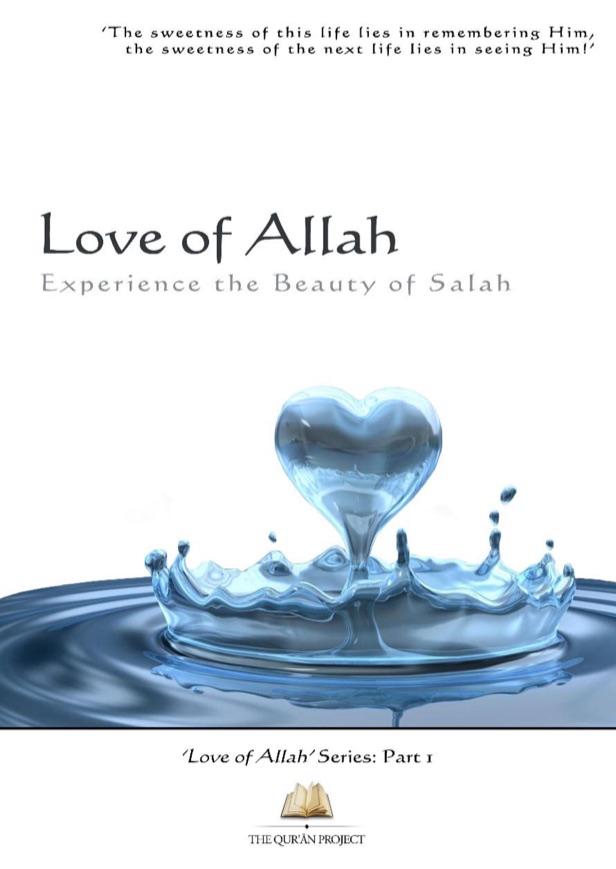
Cover of Love of Allah: Experience the Beauty of Salah: a heart of clear water rising from a splash

Our reading notes · Gardens of the Heart and Fiqh

Love of Allah: Experience the Beauty of Salah

by Mishari al-Kharraz · edited by A.B. al-Mehri · The Qur’an Project

A short guide to khushu‘ that walks through one prayer from start to finish: the opening takbir, al-Fatihah verse by verse, ruku‘, sujud, the sitting and the tashahhud, and then the adhan as a meeting being announced and wudu as getting ready to be seen. Its one argument is that we should pray out of love for Allah and longing to meet Him, not to tick off a duty. It grew out of Ramadan 2008 emails summarising Mishari al-Kharraz’s lectures on tasting the beauty of salah; its cover calls it part 1 of a “Love of Allah” series. Below are our notes on its twenty sections, one step from each for your next prayer, the words of the prayer in our own words, and links to the guide, Ayah Unpacked and our other sites.

Publisher
The Qur’an Project
Sections
20, takbir to salam
Length
About 45 pages
To read it
Free PDF

The Qur’an Project gives this book away: the button above opens their free PDF, and their page for it offers a printed copy. These notes are written in our own words; the book’s text isn’t reproduced here. Where a report needs care, or the book states one view on a question scholars differ over, we say so under “Read with care”.

الصلاة

The shape of the book

One prayer, in five stages

The book walks through a single prayer from the opening takbir to the salam, then goes back to the adhan and wudu, and ends with the five things that bring khushu‘. We have grouped its twenty sections by stage of the prayer, putting the adhan and wudu first.

الفصول

Section notes

Twenty sections, in brief

Pick a section for its main idea, the points worth remembering, anything to read with care, and pages to go deeper with on the guide, Ayah Unpacked and our other sites.

  1. 1Outlook Is Key
  2. 2Upon “Allahu Akbar”
  3. 3Salute the King & Expel the Intruder
  4. 4The Essence and Heart of Salah
  5. 5A Journey Beyond Our Limits
  6. 6Unraveling More Secrets of al-Fatihah
  7. 7A Little Shake-Up
  8. 8The Key to Salvation
  9. 9The Greatest Dua You Can Ever Make
  10. 10Concluding al-Fatihah
  11. 11Recite with the Heart
  12. 12Satisfy Your Greatest Need
  13. 13In Preparation for the Greatest Pillar
  14. 14Where True Happiness Really Lies
  15. 15The Perfect Sujood
  16. 16A Desperate Plea
  17. 17The Farewell Scene
  18. 18A Meeting Announcement: The Call to Prayer
  19. 19Fit to Be Seen
  20. 20In Summary

Chapter 1

Outlook Is Key

Before you begin · pages 4 to 6

If prayer is not changing us, the book says, the problem is usually why we pray: as a chore to get done, or to meet the One we love.

Key points

  • It opens with the focus of the early Muslims: the Ansari on guard duty who kept praying through three arrows rather than cut short a surah (Abu Dawud 198; graded hasan by an-Nawawi and Shu‘ayb al-Arna’ut), and al-Bukhari stung repeatedly by a wasp without breaking his prayer.
  • We love people for three reasons: their beauty, their kindness to us, and the favours they do us. Allah has all three beyond comparison.
  • All the beauty in creation is a faint hint of His. Musa asked to see Him, and the mountain He showed Himself to crumbled (7:143).
  • Even the favours He holds back are favours, and we sin against Him using the very gifts He gave us while He keeps protecting us.
  • So go to prayer because you miss Him, not only because it is due.

Read with care

  • The opening du‘as, and some stories. The three du‘as for Allah’s love that open the book are weakly reported. “Your love, the love of those who love You…, more beloved than cold water” is at-Tirmidhi 3490: he called it hasan gharib, and al-Albani graded it weak. “Provide me with Your love…” (at-Tirmidhi 3491) has a narrator accused of lying, Sufyan ibn Waki‘, as Ibn al-Qattan and al-Albani noted, though Ibn Hajar called it hasan. “Make Your love the most beloved thing to me” (Abu Nu‘aym) is mursal, as Ibn Rajab said. The sound way to ask for His love is the du‘a in Mu‘adh’s hadith (at-Tirmidhi 3235, hasan sahih). Among the stories, we found no source for ‘Ali turning pale at wudu.

Think aboutBefore your next prayer, name one thing that makes you love Allah. Carry it in with you.

Write a fa’idah from this chapter

Chapter 2

Upon “Allahu Akbar”

Standing, and al-Fatihah · pages 7 to 8

The opening takbir announces that the One we are about to stand before is greater than the job, the bills, the children and everything else on our minds.

Key points

  • Raising the hands is a gesture of throwing all of that behind you and surrendering.
  • Allah turns His face towards His servant in prayer for as long as the servant does not turn away (al-Harith al-Ash‘ari; al-Hakim, Ibn Khuzaymah, graded sahih by al-Albani).
  • Picture a live broadcast whose only viewer is the King who holds everything you are.
  • The servant’s sins are placed on his head and shoulders, and each bow and prostration makes them fall (graded sahih by al-Albani, Sahih al-Jami‘ 1671): another reason not to rush them.
  • Things that were allowed a moment ago, food, talk and needless movement, become forbidden: this is a meeting of a different order. Each later takbir is a chance to refocus.

Read with care

  • “Lift the veils” and “to what is better than Me?”. We found no source for Allah ordering the veils lifted when a servant prays. The report that Allah asks the one who turns away “to what is better than Me?” (from Abu Hurayrah) is weak: as-Suyuti graded it weak, Ibn ‘Uthaymin said its chain is broken, adh-Dhahabi pointed to a criticised narrator and al-Albani graded it very weak, though Ibn al-Qayyim accepted it. The sound hadith is that Allah turns His face to His servant in prayer for as long as the servant does not turn away (al-Harith al-Ash‘ari; al-Hakim, Ibn Khuzaymah).

Think aboutWhat is the one thing most likely to follow you into your next takbir? Put it down before you raise your hands.

Write a fa’idah from this chapter

Chapter 3

Salute the King & Expel the Intruder

Standing, and al-Fatihah · pages 8 to 9

Eyes lowered to the place of sujud and hands folded on the chest: the posture of a servant in a palace, not of royalty. Then a greeting for the King, and refuge from the one who wants to spoil the meeting.

Key points

  • This humility before Allah is a dignified one: it frees us from humbling ourselves before people. Whoever humbles himself for Allah, Allah raises (Muslim 2588).
  • The opening du‘a (subhanaka Allahumma…) is a greeting; the Prophet ﷺ taught several, and rotating them keeps the mind awake.
  • Shaytan is never more jealous than now. A person can finish a prayer with only a tenth of it written for him (Abu Dawud 796; graded sahih by Shu‘ayb al-Arna’ut and hasan by al-Albani).
  • Lost keys, the patterns on the rug, every errand: the flood of thoughts is his work. Seeking refuge in Allah from him (16:98) is the answer, said like you mean it.

Read with care

  • “Ninety years of prayer, six recorded”. We found no source for the picture of someone arriving with ninety years of prayer and only six counted, or for the line that only the parts of a prayer you are mindful of are accepted. The sound hadith is that a person may leave his prayer with only a tenth, a ninth or a half of it written for him (Abu Dawud 796; graded sahih by Shu‘ayb al-Arna’ut and hasan by al-Albani).

Think aboutWhich opening du‘a will you use tomorrow? Learn a second one this week.

Write a fa’idah from this chapter

Chapter 4

The Essence and Heart of Salah

Standing, and al-Fatihah · pages 9 to 11

The Prophet ﷺ would ask Bilal to call the prayer so they could find rest in it (Abu Dawud 4985): prayer was his relief, not a burden. Its heart is al-Fatihah.

Key points

  • Seek help through patience and prayer (2:45). Others look for calm in music, exercise or worse; we turn to its source.
  • Al-Fatihah is the greatest surah, and there is no prayer without it (al-Bukhari 756).
  • The first thing a lover says is the beloved’s name: Bismillah, a name that blesses whatever it touches.
  • Alhamdulillah fills the Scale (Muslim 223). Even the ability to praise Him is His gift, so in a sense He praises Himself through us.

Think aboutSay Bismillah slowly in your next prayer, as the name of someone you love.

Write a fa’idah from this chapter

Chapter 5

A Journey Beyond Our Limits

Standing, and al-Fatihah · pages 11 to 12

“Lord of the worlds”: zoom out from yourself on the prayer mat to your body’s systems, the earth, the planets, the galaxies and the unseen, until you disappear from the picture.

Key points

  • Then zoom back in and remember that the One who runs all of it is listening to you.
  • The seven heavens beside the Kursi are like a ring thrown in a desert, and the Kursi beside the Throne the same (2:255). Ibn Taymiyyah called the report well known with several routes; Ibn Hajar found a supporting chain sound; al-Albani graded it sahih through its routes.
  • If He chose someone so small for this conversation, how can we treat it lightly, or dare to defy Him afterwards?

Think aboutPicture the zoom-out once before your next prayer. How does “Lord of the worlds” sound after it?

Write a fa’idah from this chapter

Chapter 6

Unraveling More Secrets of al-Fatihah

Standing, and al-Fatihah · pages 12 to 14

Why does “the Most Merciful, the Especially Merciful” come before “Master of the Day of Judgement”? So that we face the Judge already knowing He is merciful.

Key points

  • The book’s picture: a judge who tells you at the start that he knows you are innocent, compared with one who frightens you first.
  • His rule is one of mercy: in this life He feeds and heals believer and disbeliever alike and gives a whole lifetime to return.
  • What He withholds may be the real gift: you may dislike something good for you and love something bad for you (2:216).
  • Ar-Rahman is the fullest form of mercy and is His name alone, the name tied to His rising over the Throne (20:5); ar-Rahim is His mercy reaching the believers.
  • His mercy is greater than a mother’s for her child (al-Bukhari 5999).

Think aboutRecall a time something you wanted was held back and you later saw why.

Write a fa’idah from this chapter

Chapter 7

A Little Shake-Up

Standing, and al-Fatihah · pages 14 to 16

“Master of the Day of Judgement” should make us tremble: on that Day every power people held is cancelled, and no one speaks without His leave.

Key points

  • The word is read two ways, owner (maalik) and king (malik), and both meanings are His alone that Day.
  • Nursing mothers forget their infants (22:2), a man runs from his own family (80:34-36), the heavens are rolled up in His right hand (39:67).
  • When all are gone He asks whose the dominion is today, and answers: Allah’s, the One, the Overpowering (40:16).
  • A believer’s heart swings between hope and fear. Pause on this verse long enough to feel the fear.

Think aboutPause after “Master of the Day of Judgement” in your next prayer. What comes to mind?

Write a fa’idah from this chapter

Chapter 8

The Key to Salvation

Standing, and al-Fatihah · pages 16 to 17

“You alone we worship and You alone we ask for help”: after the verse about the Day, this one gives the way through it. The book treats it as the core of al-Fatihah, and al-Fatihah as the core of the Qur’an.

Key points

  • Every Prophet brought the same message: worship none but Allah (11:26).
  • Worship is the goal; His help is the way there; sincerity is the heart of it. Deeds without sincerity are like a traveller hauling bags of sand.
  • The worst losers are those who thought their wasted work was good (18:103).
  • Teach children early that they do things because Allah loves them, and leave things because He dislikes them.
  • Sincerity is hard, which is why the verse pairs worship with asking for help: you are all astray except those He guides (Muslim 2577).

Think aboutPick one thing you will do today, and ask yourself honestly who it is for.

Write a fa’idah from this chapter

Chapter 9

The Greatest Dua You Can Ever Make

Standing, and al-Fatihah · pages 18 to 20

“Guide us to the straight path” is the most complete request there is, and al-Fatihah teaches its manners: praise first, then ask.

Key points

  • Guidance covers knowing what is right, being able to do it, wanting to do it, doing it sincerely and in the Prophet’s ﷺ way, and keeping it up.
  • There are two paths: one in this life that leads to Allah, and the bridge over Hell that leads to Paradise (19:71-72).
  • People cross that bridge at speeds set by their deeds, some like lightning and some crawling, while the Prophet ﷺ pleads for their safety (Muslim 195).
  • Steadiness on the first path is steadiness on the second.

Read with care

  • A du‘a from a heedless heart. The hadith that Allah does not answer a du‘a from a heedless heart (at-Tirmidhi 3479, which he called gharib) rests on a weak narrator, Salih al-Murri: al-Mundhiri noted that Abu Dawud and an-Nasa’i left him, and an-Nawawi and al-‘Iraqi graded it weak. Presence of heart in du‘a is still what the Qur’an and Sunnah ask of us.

Think aboutSay “guide us” in your next prayer as someone who knows they cannot cross without it.

Write a fa’idah from this chapter

Chapter 10

Concluding al-Fatihah

Standing, and al-Fatihah · pages 20 to 22

The last verses ask for the company of those Allah blessed, and protection from two failures: knowing the truth and refusing it, and following something without knowing it.

Key points

  • The blessed are the Prophets, the righteous and the Companions, and first of all our Prophet ﷺ; remembering their trials makes ours bearable.
  • Blessing is credited to Allah alone (“You blessed”), while anger is left open: wrongdoing draws the anger of Allah and of His creation.
  • Whoever’s Ameen matches the angels’ Ameen is forgiven his past sins (al-Bukhari 780).
  • Allah answers each verse of al-Fatihah: “My servant has praised Me…” (Muslim 395), so pause after each one, as the Prophet ﷺ recited verse by verse (Abu Dawud 4001).

Think aboutPause after each verse of al-Fatihah in one prayer today and imagine the reply.

Write a fa’idah from this chapter

Chapter 11

Recite with the Heart

Standing, and al-Fatihah · pages 22 to 23

The Qur’an is recited only while standing, our most dignified posture, and is due our full attention.

Key points

  • The Prophet ﷺ was forbidden to recite the Qur’an in ruku‘ and sujud (Muslim 479).
  • Many of us could not say which command or warning we just recited. We would not listen to a ruler that way.
  • Quality matters more than quantity: the Prophet ﷺ once spent a night repeating one verse (5:118; Ahmad, Shu‘ayb al-Arna’ut found its chain hasan).
  • The book passes on a simple guide it credits to Ibn al-Qayyim: verses about His names and favours call for love, verses about mercy and Paradise for hope, and verses about punishment for fear.

Think aboutChoose a short surah you know well and read its meaning before you next pray with it.

Write a fa’idah from this chapter

Chapter 12

Satisfy Your Greatest Need

Bowing and rising · pages 24 to 25

Ruku‘ is often done on autopilot, yet it is a deep act of servitude; the proud among the Arabs resisted it for that reason.

Key points

  • Back straight and level with the head, palms on the knees, still until every joint settles: “Glory be to my Lord, the Almighty.” Notice the word “my”.
  • Every person has needs: to be loved, to be alone for a while, to see their children. The deepest is the need to worship, and only worshipping Allah meets it.
  • The Prophet ﷺ said a man pecking at his prayer would die on a creed other than Muhammad’s, and that such a ruku‘ is like a hungry man eating one or two dates (Ibn Khuzaymah; graded hasan by adh-Dhahabi and al-Albani).
  • We bow at least seventeen times a day; our love for Allah should grow with each.

Read with care

  • Ibn az-Zubayr’s long ruku‘. We could not trace the report of a man reciting al-Fatihah and four long surahs while Ibn az-Zubayr stayed in ruku‘. His stillness in prayer under bombardment is reported; this detail we could not confirm.

Think aboutCount three slow breaths in your next ruku‘ before you say anything.

Write a fa’idah from this chapter

Chapter 13

In Preparation for the Greatest Pillar

Bowing and rising · pages 26 to 27

Rising from ruku‘ is its own station. Its words, “Allah hears whoever praises Him”, signal that it is time for praise before the du‘a of sujud.

Key points

  • Allah does not look at the prayer of one who does not straighten his back between ruku‘ and sujud (Ahmad; al-Mundhiri said its narrators are reliable; al-Albani called its chain good).
  • Rushing is theft: the Prophet ﷺ called the one who steals from his own prayer the worst kind of thief, not completing its bowing and prostration (Ibn Hibban 1888; graded hasan by al-Mundhiri, Shu‘ayb al-Arna’ut and al-Albani).
  • A Companion added an abundant, good and blessed praise, and the Prophet ﷺ said he saw more than thirty angels hurrying to be the first to record it (al-Bukhari 799).
  • Praise that fills the heavens, the earth and whatever else He wills admits how little we know of what He has made. No one can praise Him as He deserves except Himself.

Think aboutAdd one of the longer praises after rising from ruku‘ in your next prayer.

Write a fa’idah from this chapter

Chapter 14

Where True Happiness Really Lies

Prostration and sitting · pages 27 to 29

Sujud is the peak of submission: your most honoured part, the face, placed on the lowest spot for Him. The book argues it is also where happiness lies.

Key points

  • Happiness is near Allah: Paradise is above, al-Firdaws is beneath the Throne, and Allah consoled the Prophet ﷺ at his hardest time in Makkah by raising him to Him in the Mi‘raj.
  • Good words and deeds rise to Him (35:10). So the way up is down: whoever humbles himself for Allah is raised (Muslim 2588).
  • A servant is closest to his Lord in sujud (Muslim 482), and the Qur’an’s first revealed surah ends with “prostrate and draw near” (96:19).
  • Each prostration raises you a rank and removes a sin (Muslim 488), and Rabi‘ah ibn Ka‘b, who asked for the Prophet’s ﷺ company in Paradise, was told to help by prostrating much (Muslim 489).
  • Let the heart prostrate as well as the body; you will know when it has.

Think aboutMake one sujud today longer than any other, and stay until something in you settles.

Write a fa’idah from this chapter

Chapter 15

The Perfect Sujood

Prostration and sitting · pages 30 to 32

How the Prophet ﷺ prostrated, step by step, and what to say there.

Key points

  • Say the takbir on the way down, then the seven parts on the ground: forehead with nose, both palms, both knees and the toes of both feet, all still.
  • Fingers together and pointing to the qiblah, elbows lifted off the ground, and for men, the arms held away from the sides.
  • In sujud he never recited Qur’an but made much du‘a, and taught several glorifications to rotate.
  • Musa, asked what was in his hand, kept talking because he loved being spoken to (20:17-18). Talk to Him like that.
  • He would lengthen his prostration rather than disturb a grandchild riding on his back (an-Nasa’i 1141).

Read with care

  • Hands or knees first. The book calls hands-first the stronger opinion. Going down either way is valid, and scholars differ only over which is better; Ibn Taymiyyah said the prayer is valid either way by agreement (Majmu‘ al-Fatawa 22/449). Hands first was preferred by Malik, al-Awza‘i and al-Albani, on Abu Hurayrah’s hadith against kneeling like a camel, though al-Bukhari and Ibn Rajab doubted its chain. Knees first is the view of most scholars, including the Hanafi and Shafi‘i schools, and Ibn Baz held it, on the report of Wa’il ibn Hujr (at-Tirmidhi 268, which he called hasan gharib), though ad-Daraqutni and al-Albani found its chain weak.
  • Something between the forehead and the ground. The book says to make sure nothing, such as a head covering, comes between the forehead and the ground. Scholars differ over prostrating on something you are wearing: many hold the prayer valid and it disliked without a need, and Anas reports the Companions prostrating on the edges of their clothes in the heat (al-Bukhari 385).

Think aboutLearn one new du‘a for sujud this week and use it.

Write a fa’idah from this chapter

Chapter 16

A Desperate Plea

Prostration and sitting · pages 32 to 34

Sitting between the two prostrations is the posture of someone on their knees waiting for a verdict, like the nations kneeling on the Day of Judgement (45:28).

Key points

  • The words for it: “My Lord, forgive me”, again and again.
  • The Prophet ﷺ sat here as long as he prostrated, asking for forgiveness, mercy, mending, guidance, wellbeing, provision and a raised rank (Abu Dawud 850, at-Tirmidhi 284, Ibn Majah 898; the wordings vary).
  • On the Day of Judgement he will prostrate long before the Throne until told to raise his head and intercede (al-Bukhari 7510).
  • One sujud is not enough, so a second follows: each rak‘ah begins with recitation and ends in prostration, like the first revealed surah.

Think aboutSay “my Lord, forgive me” at least three times between your prostrations today, slowly.

Write a fa’idah from this chapter

Chapter 17

The Farewell Scene

Ending, and keeping it · pages 34 to 36

The tashahhud closes the meeting: greetings to Allah, peace on the Prophet ﷺ, peace on all the righteous, and the testimony of faith.

Key points

  • All greetings, prayers and good words belong to Allah.
  • Whoever sends peace on the Prophet ﷺ, Allah returns his soul so he can return the greeting (Abu Dawud 2041), and Allah blesses whoever blesses him once ten times over (Muslim 408).
  • The book asks you to picture him entering the room to greet only you.
  • Whoever’s last words are la ilaha illallah enters Paradise (Abu Dawud 3116), and death will always come between two prayers.
  • Before the salam, send blessings on him, ask forgiveness for yourself and your parents, and ask for the best of both worlds; afterwards, seek forgiveness three times (Muslim 591).

Read with care

  • “Your du‘as here are guaranteed”. The book says du‘as made at the end of the prayer are guaranteed to be answered. The sound hadith tell us to choose the du‘a we like before the salam (al-Bukhari 835) and name the end of the obligatory prayers as a time when du‘a is most heard (at-Tirmidhi 3499, which he called hasan): a time of hope, not a guarantee.

Think aboutChoose one du‘a to make before the salam in every prayer this week.

Write a fa’idah from this chapter

Chapter 18

A Meeting Announcement: The Call to Prayer

Before you begin · pages 37 to 39

Prayer begins at the adhan: whoever waits for prayer is counted as praying (al-Bukhari 659), and Shaytan flees the call (al-Bukhari 608).

Key points

  • Allahu akbar: leave the work, the family and the sleep, He is greater. La ilaha illallah: nothing else deserves to be put first.
  • The two testimonies set the two conditions for any deed: sincerity to Allah and following His Messenger (18:110).
  • At “come to prayer” and “come to success” we answer: there is no power or strength except through Allah (Muslim 385).
  • The book’s tip is to say what the muadhin says; the hadith adds that whoever does so and then asks will be given (Abu Dawud 524).
  • Hear the adhan like a child at the airport hearing that their mother’s plane has landed, and hurry as Musa did to his Lord (20:84).

Read with care

  • The muadhin’s reward. The book says the one who calls the adhan is rewarded for every person who prays because of his call, and that repeating the adhan after him earns the same. Scholars differ over the first: Shu‘ayb al-Arna’ut graded an-Nasa’i’s hadith sound except for that phrase, al-Mundhiri found Abu Umamah’s version good and al-Haythami found it weak. For the second, the hadith promises that whoever repeats the adhan and then asks will be given (Abu Dawud 524), not the muadhin’s own reward.

Think aboutRepeat the next adhan you hear word for word, then ask Allah for one thing.

Write a fa’idah from this chapter

Chapter 19

Fit to Be Seen

Before you begin · pages 39 to 41

Wudu is usually done on habit, with the hands but not the heart. With intention it weighs far more.

Key points

  • Intend obedience to the command in 5:6, following the Prophet ﷺ, and washing away sins.
  • A perfected wudu washes sins out with the last drop of water, even from under the nails (Muslim 244, 245).
  • Finish with the testimony, and the eight gates of Paradise open (Muslim 234), adding the du‘a to be among those who repent and keep clean (at-Tirmidhi 55).
  • The traces of wudu will shine on this ummah’s faces and limbs on the Day of Judgement, and the Prophet ﷺ longed to see us, his brothers who came later (Muslim 249).
  • Bilal’s footsteps were heard ahead of the Prophet ﷺ in Paradise. In the book’s telling, as in at-Tirmidhi 3689, it was because he prayed two rak‘ahs after every adhan and renewed his wudu whenever he lost it; in al-Bukhari 1149 he prays after every wudu.

Read with care

  • Washing beyond the limbs. The book says the Prophet ﷺ told us to wash beyond the elbows and ankles for more light. The line “whoever can lengthen his brightness, let him do so” is Abu Hurayrah’s own addition according to Ibn Taymiyyah (as Ibn al-Qayyim reports in Hadi al-Arwah), Ibn al-Qayyim, al-‘Ayni, Ibn Baz and al-Albani; Ibn ‘Uthaymin noted that scholars differ. The du‘a to be among those who repent and keep clean (at-Tirmidhi 55) was graded good by Ibn Baz and Shu‘ayb al-Arna’ut, though adh-Dhahabi doubted it.

Think aboutIn your next wudu, picture the sins of each limb washing away as you wash it.

Write a fa’idah from this chapter

Chapter 20

In Summary

Ending, and keeping it · pages 41 to 45

The first deed we will be asked about is prayer, and a prayer that is sound carries the rest. The book ends with the five things that bring khushu‘.

Key points

  • Presence of heart: give Allah ten undistracted minutes of the twenty-four hours.
  • Understanding the words and actions: we can focus through a two-hour film or an exam.
  • Hope that moves you to act (39:53), and awe (hayba) of the One who could replace us with a new creation (35:15-16). Jibril himself was like a worn saddle-cloth from awe of Allah on the night of the Mi‘raj (Ibn Hajar called the chain strong; al-Haythami said its narrators are those of the Sahih).
  • Love, and a shy shame at how patiently He covers us.
  • Shaytan robs a rich house with no guards. Most people feel khushu‘ in the du‘a at the end of the Ramadan night prayers because they know they are speaking to Him: prayer is a conversation, not a recital.

Read with care

  • ‘Ali and the trust. The book says ‘Ali shook and went pale when prayer time came, saying the time had come to carry the trust offered to the heavens, the earth and the mountains (33:72); in section 1 it also says he went pale while making wudu. We found no chain for either; read them as stories told about him.

Think aboutWhich of the five is weakest in your prayer? Work on that one first.

Write a fa’idah from this chapter

العمل

Put it into practice

For your next prayer, and its words

One step from each section, to tick off as they become part of how you pray, and the words of the prayer the book walks through, in our own words with their sources.

20 steps, one from each section

Take one into each prayer, or start with the ones you need most, and tick them off as they become habits.

0 of 20 done

Your ticks are kept in this browser only.

  1. Name one reason you love Him on the way.

    Sec. 1: Outlook Is Key

  2. He is greater than it.

    Sec. 2: Upon “Allahu Akbar”

  3. And your hands folded, like a servant.

    Sec. 3: Salute the King & Expel the Intruder

  4. A new greeting wakes the mind.

    Sec. 3: Salute the King & Expel the IntruderDhikr inside the prayer How to Muslim guide

  5. Then let Alhamdulillah be real thanks.

    Sec. 4: The Essence and Heart of Salah

  6. From your body to the galaxies.

    Sec. 5: A Journey Beyond Our Limits

  7. Mercy first, then the Day.

    Sec. 6: Unraveling More Secrets of al-Fatihah

  8. Let it shake you a little.

    Sec. 7: A Little Shake-Up

  9. You alone we worship.

    Sec. 8: The Key to Salvation

  10. It does.

    Sec. 9: The Greatest Dua You Can Ever Make

  11. He is answering.

    Sec. 10: Concluding al-FatihahSurah al-Fatihah mind map Ayah Unpacked

  12. Then pray with it.

    Sec. 11: Recite with the HeartHow to read the Qur’an How to Muslim guide

  13. Three slow breaths.

    Sec. 12: Satisfy Your Greatest Need

  14. And add a longer praise.

    Sec. 13: In Preparation for the Greatest Pillar

  15. Stay until something settles.

    Sec. 14: Where True Happiness Really Lies

  16. Forehead and nose, palms, knees, toes.

    Sec. 15: The Perfect SujoodHow to pray How to Muslim guide

  17. My Lord, forgive me, more than once.

    Sec. 16: A Desperate Plea

  18. For yourself and your parents.

    Sec. 17: The Farewell SceneWhat to say after salah How to Muslim guide

  19. And answer “come to prayer” with la hawla.

    Sec. 18: A Meeting Announcement: The Call to Prayer

  20. Picture each limb’s sins washing away.

    Sec. 19: Fit to Be SeenHow to make wudu How to Muslim guide

The words of the prayer

What the book asks you to say at each stage, in our own words with where it is narrated. Learn the Arabic from a teacher or a trusted collection.

  • After the opening takbir

    Glory be to You, O Allah, and praise; blessed is Your name, high is Your majesty, and there is no god but You.

    Abu Dawud 776, at-Tirmidhi 243Sec. 3

  • Before reciting

    I seek refuge in Allah from Shaytan, the outcast.

    Qur’an 16:98Sec. 3

  • In ruku‘

    Glory be to my Lord, the Almighty.

    Muslim 772Sec. 12

  • Rising from ruku‘

    Allah hears whoever praises Him. Our Lord, to You belongs the praise: abundant, good and blessed praise.

    al-Bukhari 799Sec. 13

  • Standing after ruku‘

    Praise that fills the heavens and the earth, all that is between them, and whatever else You will.

    Muslim 478Sec. 13

  • In sujud

    Glory be to my Lord, the Most High.

    Muslim 772Sec. 15

  • Also in sujud

    Glory be to You, O Allah our Lord, and praise; O Allah, forgive me.

    al-Bukhari 817Sec. 15

  • Also in sujud

    All-Glorious, All-Holy, Lord of the angels and of the Spirit.

    Muslim 487Sec. 15

  • Also in sujud

    O Allah, I take refuge in Your pleasure from Your anger, in Your pardon from Your punishment, and in You from You. I cannot count Your praises; You are as You have praised Yourself.

    Muslim 486Sec. 15

  • Between the two prostrations

    O Allah, forgive me, have mercy on me, mend what is broken in me, guide me, keep me well, provide for me and raise me.

    Abu Dawud 850, at-Tirmidhi 284, Ibn Majah 898 (the wordings vary)Sec. 16

  • The tashahhud

    All greetings, prayers and good words are for Allah. Peace be on you, O Prophet, with Allah’s mercy and blessings. Peace be on us and on Allah’s righteous servants. I bear witness that there is no god but Allah, and that Muhammad is His servant and Messenger.

    al-Bukhari 831Sec. 17

  • Blessings on the Prophet ﷺ

    O Allah, send blessings on Muhammad and his family as You sent them on Ibrahim and his family; and send grace on Muhammad and his family as You sent it on Ibrahim and his family. You are Praiseworthy, Glorious.

    al-Bukhari 3370Sec. 17

  • Answering “come to prayer”

    There is no power and no strength except through Allah.

    Muslim 385Sec. 18

  • After wudu

    I bear witness that there is no god but Allah alone, without partner, and that Muhammad is His servant and Messenger. O Allah, make me one of those who often turn back to You, and one of those who keep themselves pure.

    Muslim 234; at-Tirmidhi 55 (see Read with care)Sec. 19

  • For His love

    O Allah, I ask You for Your love, the love of whoever loves You, and the love of deeds that bring me close to Your love.

    at-Tirmidhi 3235, from Mu‘adh (hasan sahih)Sec. 1

The whole prayer, step by step, is in the How to Muslim guide.

المزيد

Keep going

Read with care, then read on

A few narrations and details in the book that need care, and our sites that go deeper.

Details to read with care

The book is warm and practical, but it opens with weakly reported du‘as, uses a few reports with weak chains or none, credits two stories of the Successors to Companions, and gives one view as settled on questions scholars differ over. Here they are, section by section.

  • Section 1 and the front pages

    The opening du‘as, and some stories

    The three du‘as for Allah’s love that open the book are weakly reported. “Your love, the love of those who love You…, more beloved than cold water” is at-Tirmidhi 3490: he called it hasan gharib, and al-Albani graded it weak. “Provide me with Your love…” (at-Tirmidhi 3491) has a narrator accused of lying, Sufyan ibn Waki‘, as Ibn al-Qattan and al-Albani noted, though Ibn Hajar called it hasan. “Make Your love the most beloved thing to me” (Abu Nu‘aym) is mursal, as Ibn Rajab said. The sound way to ask for His love is the du‘a in Mu‘adh’s hadith (at-Tirmidhi 3235, hasan sahih). Among the stories, we found no source for ‘Ali turning pale at wudu.

    See our page
  • Section 2

    “Lift the veils” and “to what is better than Me?”

    We found no source for Allah ordering the veils lifted when a servant prays. The report that Allah asks the one who turns away “to what is better than Me?” (from Abu Hurayrah) is weak: as-Suyuti graded it weak, Ibn ‘Uthaymin said its chain is broken, adh-Dhahabi pointed to a criticised narrator and al-Albani graded it very weak, though Ibn al-Qayyim accepted it. The sound hadith is that Allah turns His face to His servant in prayer for as long as the servant does not turn away (al-Harith al-Ash‘ari; al-Hakim, Ibn Khuzaymah).

    See our page
  • Section 3

    “Ninety years of prayer, six recorded”

    We found no source for the picture of someone arriving with ninety years of prayer and only six counted, or for the line that only the parts of a prayer you are mindful of are accepted. The sound hadith is that a person may leave his prayer with only a tenth, a ninth or a half of it written for him (Abu Dawud 796; graded sahih by Shu‘ayb al-Arna’ut and hasan by al-Albani).

  • Section 9

    A du‘a from a heedless heart

    The hadith that Allah does not answer a du‘a from a heedless heart (at-Tirmidhi 3479, which he called gharib) rests on a weak narrator, Salih al-Murri: al-Mundhiri noted that Abu Dawud and an-Nasa’i left him, and an-Nawawi and al-‘Iraqi graded it weak. Presence of heart in du‘a is still what the Qur’an and Sunnah ask of us.

    See our page
  • Section 12

    Ibn az-Zubayr’s long ruku‘

    We could not trace the report of a man reciting al-Fatihah and four long surahs while Ibn az-Zubayr stayed in ruku‘. His stillness in prayer under bombardment is reported; this detail we could not confirm.

    See our page
  • Section 15

    Hands or knees first

    The book calls hands-first the stronger opinion. Going down either way is valid, and scholars differ only over which is better; Ibn Taymiyyah said the prayer is valid either way by agreement (Majmu‘ al-Fatawa 22/449). Hands first was preferred by Malik, al-Awza‘i and al-Albani, on Abu Hurayrah’s hadith against kneeling like a camel, though al-Bukhari and Ibn Rajab doubted its chain. Knees first is the view of most scholars, including the Hanafi and Shafi‘i schools, and Ibn Baz held it, on the report of Wa’il ibn Hujr (at-Tirmidhi 268, which he called hasan gharib), though ad-Daraqutni and al-Albani found its chain weak.

    See our page
  • Section 15

    Something between the forehead and the ground

    The book says to make sure nothing, such as a head covering, comes between the forehead and the ground. Scholars differ over prostrating on something you are wearing: many hold the prayer valid and it disliked without a need, and Anas reports the Companions prostrating on the edges of their clothes in the heat (al-Bukhari 385).

  • Section 17

    “Your du‘as here are guaranteed”

    The book says du‘as made at the end of the prayer are guaranteed to be answered. The sound hadith tell us to choose the du‘a we like before the salam (al-Bukhari 835) and name the end of the obligatory prayers as a time when du‘a is most heard (at-Tirmidhi 3499, which he called hasan): a time of hope, not a guarantee.

  • Section 18

    The muadhin’s reward

    The book says the one who calls the adhan is rewarded for every person who prays because of his call, and that repeating the adhan after him earns the same. Scholars differ over the first: Shu‘ayb al-Arna’ut graded an-Nasa’i’s hadith sound except for that phrase, al-Mundhiri found Abu Umamah’s version good and al-Haythami found it weak. For the second, the hadith promises that whoever repeats the adhan and then asks will be given (Abu Dawud 524), not the muadhin’s own reward.

  • Section 19

    Washing beyond the limbs

    The book says the Prophet ﷺ told us to wash beyond the elbows and ankles for more light. The line “whoever can lengthen his brightness, let him do so” is Abu Hurayrah’s own addition according to Ibn Taymiyyah (as Ibn al-Qayyim reports in Hadi al-Arwah), Ibn al-Qayyim, al-‘Ayni, Ibn Baz and al-Albani; Ibn ‘Uthaymin noted that scholars differ. The du‘a to be among those who repent and keep clean (at-Tirmidhi 55) was graded good by Ibn Baz and Shu‘ayb al-Arna’ut, though adh-Dhahabi doubted it.

    See our page
  • Section 20

    ‘Ali and the trust

    The book says ‘Ali shook and went pale when prayer time came, saying the time had come to carry the trust offered to the heavens, the earth and the mountains (33:72); in section 1 it also says he went pale while making wudu. We found no chain for either; read them as stories told about him.

    See our page

فوائد

Your fawa’id

Write down what this book taught you

Each fa’idah is saved in your Rawdah notebook under Love of Allah, with the chapter it came from. Your notebook page keeps them all, book by book.

Notes are kept in this browser only. Download a copy from your notebook page to keep them safe.

From this book0 notes

    Nothing yet. Your first fa’idah from this book will appear here.

    Open your whole notebook