روضة RawdahLibrary of How to Muslim
  1. Rawdah
  2. Seerah and History
  3. The Final Prophet
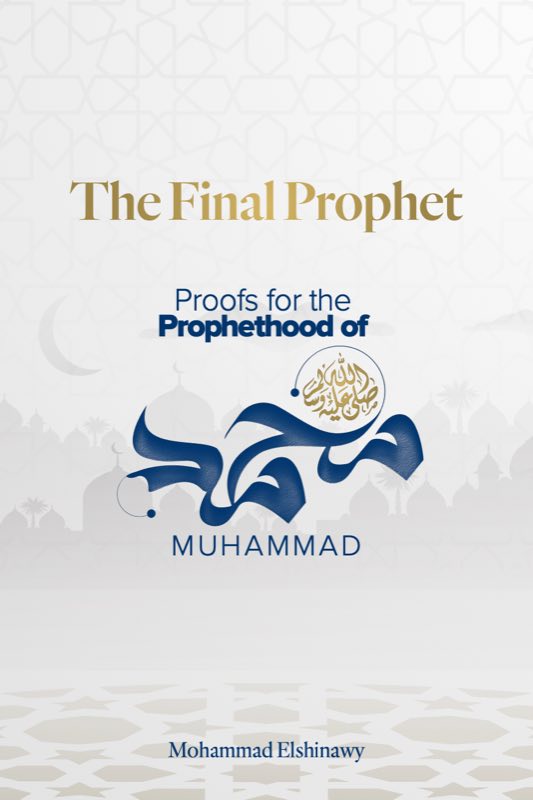
Cover of The Final Prophet: Proofs for the Prophethood of Muhammad by Mohammad Elshinawy: the title in gold and blue, with the name Muhammad in Arabic calligraphy over a faint skyline of domes

Our reading notes · Gardens of the Seerah and Belief

The Final Prophet

by Mohammad Elshinawy · Yaqeen Institute, 2022 · Proofs for the Prophethood of Muhammad ﷺ

A clear, warm case for why Muhammad ﷺ was God’s final messenger, written by a Yaqeen Institute researcher who began asking these questions at thirteen. It moves from why people need prophets at all, through his honesty, mercy and courage, what he achieved, the wisdom of his message and the prophecies that came true, to his miracles and the Qur’an itself, and ends with Abu Sufyan’s journey to faith. Below are our notes on its 46 sections, a step from each to try, his words in our own renderings, and links to Prophetic Footsteps, Ayah Unpacked and our other sites.

Publisher
Yaqeen Institute
Chapters
7, in 46 sections
Length
About 230 pages
To read it
On Yaqeen’s site

Yaqeen Institute publishes the book on its page for the book. These notes follow the 2022 edition, in our own words; the book’s text isn’t reproduced here. Where a report is graded differently by scholars, or a detail needs correcting, we say so under “Read with care”.

الأخلاق

The shape of the book

Seven chapters, Forty-six sections

The book builds its case step by step: why we need prophets, then his character, his achievements, his message, his prophecies, his miracles and finally the Qur’an. We have kept its order and split its chapters into 46 sections; its thirty-one prophecies are grouped into seven.

الفصول

Section notes

Forty-six sections, in brief

Pick a section for its main idea, the points worth remembering, anything to read with care, and pages to go deeper with on Prophetic Footsteps, Ayah Unpacked and our other sites.

  1. 1The thirst for certainty
  2. 2A need of the soul
  3. 3Why “just be good” is not enough
  4. 4The world before him
  5. 5The prophet the scriptures awaited
  6. 6Honest even with his enemies
  7. 7A ruler on a straw mat
  8. 8Mercy to the worlds
  9. 9Forgiveness at the height of power
  10. 10Courage from certainty
  11. 11The most generous of people
  12. 12Patience through every loss
  13. 13A love larger than life
  14. 14History’s greatest success story
  15. 15Giving God back to people
  16. 16Human dignity for all
  17. 17A generation like no other
  18. 18Pure monotheism
  19. 19Trust in destiny
  20. 20The prayer: a lifeline
  21. 21Fasting: freedom from appetite
  22. 22Protecting chastity and the family
  23. 23Wealth without interest
  24. 24Leaving alcohol completely
  25. 25Eating well and keeping clean
  26. 26A religion of knowledge
  27. 27Rome, Abu Lahab and a faith for the world
  28. 28News from afar
  29. 29Conquests, safe roads and the last emperors
  30. 30His family and Companions
  31. 31Trials among believers, and their healing
  32. 32Hidden hearts and the Qur’an alone
  33. 33Signs before the Hour
  34. 34Can miracles happen, and can we know?
  35. 35The moon split
  36. 36The Night Journey
  37. 37A trunk that wept, stones that praised
  38. 38Water from his fingers, food that did not run out
  39. 39Prayers that were answered
  40. 40A language no one could match
  41. 41Muhammad or Shakespeare?
  42. 42Knowledge of a lost past
  43. 43Preserved as promised
  44. 44The power to move hearts
  45. 45Verses he would not have written
  46. 46“This is prophethood”

Chapter 1

The thirst for certainty

Pages 1 to 10 · Why we need prophets

The author was thirteen, in New York, when he asked his mother how we know Islam is true, and her answer, “just have faith”, sent him searching. This book is the guide he wishes he had found. The Preface places it in a long Muslim tradition of “proofs of prophethood” books and explains why there are so many kinds of proof.

Key points

  • Muslim scholars have written on the proofs of prophethood since the eighth or ninth century. Imam ash-Shafi‘i is said to have written the first such book, and al-Bayhaqi’s Dala’il an-Nubuwwah is the best known of over ninety titles. Faith in Islam has always welcomed evidence.
  • The first proof is within us. Every human society has worshipped something, and Allah gave us both a longing for Him and the trust that our minds can find the truth. Descartes himself needed a God who does not deceive before he could trust his own reasoning.
  • People came to the Prophet ﷺ by different roads. ‘Abdullah ibn Salam saw his face and knew it was not the face of a liar (at-Tirmidhi 2485; sahih, Darussalam); Quraysh admitted they had never known him to lie (al-Bukhari 4770). The proofs are many so that every kind of person has a way in.
  • An honest seeker will find the signs clear; the Qur’an says some would call even an open gate in the sky a trick of the eyes (Al-Hijr 15:14-15Read it word by word, and listenSee it on the Ayah Unpacked mapRead it on Quran.comAlso in the libraryNo other book here cites it yet.Every verse in our notes). What decides it is the heart’s willingness, not the strength of the evidence.
  • Believing in all the prophets is part of faith, and Muhammad ﷺ is the last of them (Al-Ahzab 33:40Read it word by word, and listenSee it on the Ayah Unpacked mapRead it on Quran.comAlso in the libraryNo other book here cites it yet.Every verse in our notes). The book’s order follows that: why we need prophets, why he is one, and finally why the Qur’an is from God.

Think aboutWhat first made Islam feel true to me: a person, a verse, a proof or an answered prayer? Which road would help a friend who is searching now?

Write a fa’idah from this chapter

Chapter 2

A need of the soul

Pages 11 to 14 · Why we need prophets

Worship is not only a duty but a human need, as real as food and air. Without prophets we could not know Allah well enough to love Him, and the soul keeps chasing mirages that leave it thirstier.

Key points

Think aboutWhen I feel restless, what do I reach for first? What would it look like to reach for remembrance instead?

Write a fa’idah from this chapter

Chapter 3

Why “just be good” is not enough

Pages 14 to 16 · Why we need prophets

Kindness and justice are good in themselves, but the author argues that goodness needs its Giver and its definition. Prophets both point us to the One who gave us every faculty we do good with, and show us what good actually is.

Key points

  • Every good deed uses gifts we did not make: life, intention, strength, wealth. Doing good while denying the Giver is, the author says, like publishing research and hiding the true author.
  • “Do no harm” and the golden rule are accepted by almost everyone, yet people still disagree on what they mean in a hard case. Revelation fills in what reason leaves open.
  • History is full of educated, well-meaning people whose ideas did slow, hidden damage. Guidance protects us from our own blind spots (Al-Hujurat 49:7Read it word by word, and listenSee it on the Ayah Unpacked mapRead it on Quran.comAlso in the libraryNo other book here cites it yet.Every verse in our notes).
  • Tawhid, singling Allah out in all that is His alone, is the greatest good of all, and no one could know it in detail without the messengers.

Think aboutWhich of my “good” habits do I do for Allah, and which only to feel like a good person?

Write a fa’idah from this chapter

Chapter 4

The world before him

Pages 16 to 18 · Why we need prophets

The author describes the sixth century, which a Harvard historian has called one of the worst times to be alive, and argues that a merciful God would not leave such a world without guidance.

Key points

  • The Prophet ﷺ said Allah looked at the people of the earth and found them hateful to Him, Arab and non-Arab, except a few remnants of the People of the Book, and then sent him with a Book (Muslim 2865).
  • Michael McCormick has argued that 536 CE, with its volcanic winters and famine, began one of the worst periods in recorded history.
  • Cruelty was ordinary: crowds cheered as people were mauled in arenas, infant girls were buried alive in Arabia, many were born into slavery with no way out, and in many lands women had few rights.
  • Allah sent the final Prophet so that whoever perished would do so after clear proof, and whoever lived would live by clear proof (Al-Anfal 8:42Read it word by word, and listenSee it on the Ayah Unpacked mapRead it on Quran.comAlso in the libraryNo other book here cites it yet.Every verse in our notes).

Think aboutWhich “normal” things of my own time might later generations see the way we see the sixth century?

Write a fa’idah from this chapter

Chapter 5

The prophet the scriptures awaited

Pages 19 to 27 · Why we need prophets

The author gathers passages from the Bible that, taken together, point to a final prophet from Ishmael’s line. No single verse names Muhammad ﷺ, but the passages fit him better than anyone else, which is why the Qur’an says the learned of the Children of Israel recognised him (Ash-Shu’ara 26:197Read it word by word, and listenSee it on the Ayah Unpacked mapRead it on Quran.comAlso in the libraryNo other book here cites it yet.Every verse in our notes).

Key points

  • Deuteronomy Al-Kahf 18:18Read it word by word, and listenSee it on the Ayah Unpacked mapRead it on Quran.comAlso in the libraryNo other book here cites it yet.Every verse in our notes promises a prophet like Moses from among the Israelites’ “brethren”, and the Bible uses that word of neighbouring peoples too. Moses and Muhammad ﷺ were alike in many ways: born of two parents, married with children, bringers of a full law, driven from home, victorious over their oppressors, and buried after a natural death.
  • Asked if he was “the Prophet”, John the Baptist said no (John 1:19 to 21): people were still waiting for one prophet so well known he needed no name.
  • Isaiah 42 speaks of a gentle servant who will not shout in the streets and will bring justice to the nations, with the settlements of Kedar, Ishmael’s son, rejoicing. ‘Abdullah ibn ‘Amr ibn al-‘As said the Torah described the Prophet ﷺ as not harsh and not loud in the markets, repaying evil with forgiveness (al-Bukhari 2125).
  • Jesus spoke of a Helper who would come only after he left and would guide to all truth. The Prophet ﷺ said he is the closest of people to Jesus, son of Mary, since the prophets are brothers with one religion and no prophet came between them (Muslim 2365).
  • Hagar’s well in the wilderness of Paran (Genesis 21) became Zamzam, still flowing beside the Ka‘bah that Abraham built. The Qur’an says those who follow the unlettered prophet find him described in their Torah and Gospel (Al-A’raf 7:157Read it word by word, and listenSee it on the Ayah Unpacked mapRead it on Quran.comAlso in the libraryNo other book here cites it yet.Every verse in our notes).

Think aboutDo I know the story of Hagar, Ishmael and Zamzam well enough to tell it to a Christian or Jewish friend?

Write a fa’idah from this chapter

Chapter 6

Honest even with his enemies

Pages 28 to 34 · His character

Chapter 2 opens with Jesus’ test for prophets, “by their fruits you will know them”, and applies it first to the Prophet’s ﷺ honesty. Liars who claimed prophethood have always been exposed in time; he was trusted by the very people who fought him.

Key points

  • His people called him al-Amin, the Trustworthy. Even while persecuting him they kept their valuables with him, and when he migrated he left ‘Ali behind for three days to return every deposit to its owner.
  • Ibn Taymiyyah wrote that a person claiming prophethood must be either the best of people or the worst, and those two are never hard to tell apart for long.
  • Questioned by the emperor Heraclius, his enemy Abu Sufyan admitted the Prophet ﷺ had never lied or broken a promise. Heraclius reasoned that a man who would not lie about people would not lie about God (al-Bukhari 7).
  • When the sun eclipsed on the day his son Ibrahim died, people said it was for Ibrahim. Grieving, he still stood up to correct them: eclipses happen for no one’s death or birth (al-Bukhari 1060, Muslim 915). An impostor would have welcomed the rumour.
  • Before Badr, outnumbered three to one, he sent Hudhayfah and his father home because they had promised Quraysh not to fight: “we keep our word to them” (Muslim 1787).

Think aboutIs there a convenient half-truth I let stand because it makes me look good?

Write a fa’idah from this chapter

Chapter 7

A ruler on a straw mat

Pages 34 to 38 · His character

By the end of his life the Prophet ﷺ ruled Arabia, and thousands would have given him anything. Yet nothing in his home or habits showed luxury, which the author argues is hard to explain if his mission served himself.

Key points

  • His room was so small that ‘A’ishah had to move her legs for him to prostrate. For months no fire was lit for cooking in his house; they lived on dates and water (al-Bukhari 6459).
  • ‘Umar wept to see the marks of a straw mat on his side while Caesar and Chosroes lived in luxury. The Prophet ﷺ asked him whether he was not content that they have this world and we have the next (Muslim 1479).
  • His Companions loved him more than anyone, yet did not stand up when he entered because he disliked it (at-Tirmidhi 2754; sahih, Darussalam).
  • He carried bricks for the first masjid (al-Bukhari 3906), let the weakest take him by the hand to see to their needs, and noticed when his wife was upset with him (al-Bukhari 5228).
  • He called himself the last brick in the house of prophethood (Muslim 2286) and warned: do not exaggerate in praising me as the Christians did the son of Mary; call me Allah’s servant and messenger (al-Bukhari 3445).

Think aboutWhat do I own or do mainly so that others will see it?

Write a fa’idah from this chapter

Chapter 8

Mercy to the worlds

Pages 39 to 42 · His character

‘A’ishah said his character was the Qur’an, and the Qur’an’s first note is mercy. The author shows that mercy reaching children, animals and even those who rejected him.

Key points

Think aboutWho in my house, street or workplace most needs my mercy this week?

Write a fa’idah from this chapter

Chapter 9

Forgiveness at the height of power

Pages 42 to 47 · His character

The early Muslims were tortured, starved and killed, and the Prophet ﷺ himself was strangled, spat on and stoned. Yet when he had power he took no revenge, and some of his fiercest enemies became his most devoted followers.

Key points

  • In Makkah he prayed for Allah to strengthen Islam with either Abu Jahl or ‘Umar (at-Tirmidhi 3681; hasan, Darussalam). Even his worst enemy was someone he hoped to win.
  • When some men greeted him with “death be upon you”, he told ‘A’ishah to be gentle, for Allah loves gentleness in all things (al-Bukhari 6927).
  • At Uhud his tooth was broken and his face cut, and he asked how a people could succeed after wounding their Prophet (Muslim 1791). When asked to curse the idolaters, he said he was sent as a mercy, not to curse (Muslim 2599). He also told of an earlier prophet who wiped the blood from his face and asked Allah to forgive his people, for they did not know (al-Bukhari 3477).
  • A man drew the Prophet’s ﷺ own sword on him as he slept. Allah protected him, the sword was lowered, and he let the man go unpunished (al-Bukhari 2910).
  • Hind, who had celebrated over the body of his uncle Hamzah, was welcomed when she became Muslim. Wahshi, who killed Hamzah, went to Ta’if after Makkah opened; told that the Prophet ﷺ did not harm envoys, he came with the Ta’if delegation, accepted Islam and was spared (al-Bukhari 4072).

Think aboutIs there someone I am still “keeping score” with whom I could forgive today?

Write a fa’idah from this chapter

Chapter 10

Courage from certainty

Pages 47 to 48 · His character

A man unsure of his mission would protect himself. The Prophet ﷺ stood closest to the enemy, which the author reads as the courage of someone certain of his truth.

Key points

  • ‘Ali said that at Badr they took cover behind the Prophet ﷺ, who was nearest of all to the enemy (Ahmad 654; chain sahih per al-Arna’ut and Ahmad Shakir).
  • At Hunayn, when the ranks broke under arrows, he stood his ground calling out that he was the Prophet, no lie, and the son of ‘Abd al-Muttalib (al-Bukhari 2864, Muslim 1776).
  • After Allah promised to protect him (Al-Ma’idah 5:67Read it word by word, and listenSee it on the Ayah Unpacked mapRead it on Quran.comAlso in the libraryNo other book here cites it yet.Every verse in our notes), he told the Companions who guarded him at night to go home (at-Tirmidhi 3046; at-Tirmidhi called it gharib).
  • When a noise woke Madinah one night, he was already riding back alone, bareback, to tell them it was a false alarm (al-Bukhari 3040).

Think aboutWhat fear stops me from standing up for something I know is right?

Write a fa’idah from this chapter

Chapter 11

The most generous of people

Pages 48 to 50 · His character

He never ate from charity he collected, gave even to enemies, and could not rest while money sat in his house.

Key points

  • The rabbi Zayd ibn Su‘nah grabbed his cloak days before a loan was due to test him. The Prophet ﷺ told ‘Umar to repay him and add extra for the fright ‘Umar gave him, and Zayd became Muslim, having seen that his patience overcame anger (Ibn Hibban 288; see Read with care).
  • A Bedouin yanked his cloak so hard it left marks on his neck, demanding money; he smiled and ordered him a gift (al-Bukhari 6088).
  • After ‘asr he hurried home because he remembered some gold left in the house and did not want it to stay overnight (al-Bukhari 1221).

Read with care

  • The story of Zayd ibn Su‘nah. The rabbi who tested the Prophet’s ﷺ patience over a loan is in Ibn Hibban and al-Hakim. Al-Hakim called its chain sahih and Ibn Hajar called the story well known, while adh-Dhahabi called it gharib (a single, unusual chain). Enjoy it as a well-known report rather than a sound hadith to build on.

Think aboutIs there money or an item I am holding on to that would do more good in someone else’s hands today?

Write a fa’idah from this chapter

Chapter 12

Patience through every loss

Pages 50 to 57 · His character

He was orphaned, lost his wife and uncle in one year, buried six of his seven children, was boycotted, stoned and driven from home, yet remained hopeful, gentle and grateful. The author asks whether such a heart could have kept going without help from above.

Key points

  • For three years his clan was besieged in the valley of Abu Talib until people ate leaves; Khadijah and Abu Talib died soon after.
  • At Ta’if they stoned him until he bled. When the angel of the mountains offered to bring the two mountains down on those who rejected him, he said he hoped Allah would bring from their descendants people who worship Him alone (al-Bukhari 3231, Muslim 1795).
  • Hidden in the cave with trackers at the entrance, he told Abu Bakr: what do you think of two when Allah is their third? (al-Bukhari 3653, Muslim 2381; At-Tawbah 9:40Read it word by word, and listenSee it on the Ayah Unpacked mapRead it on Quran.comAlso in the libraryNo other book here cites it yet.Every verse in our notes).
  • His Companions were people of rare calibre, like ‘Umar, whose administration historians still admire, and Bilal and Sumayyah, who chose torture over denying him. Their certainty in him was formed by years of seeing him close up.
  • Even William Montgomery Watt concluded that to call him an impostor raises more problems than it solves.

Think aboutWhich hardship of mine might Allah be using to bring good I cannot yet see?

Write a fa’idah from this chapter

Chapter 13

A love larger than life

Pages 58 to 67 · What he achieved

Chapter 3 asks what the Prophet ﷺ achieved, and starts with the love he inspired, then and now. Ibn Hazm said his biography alone would be enough of a miracle.

Key points

  • At Uhud, Abu Dujanah shielded him with his back full of arrows, Abu Talhah begged to be struck instead of him, and Nusaybah bint Ka‘b fought in his defence. A woman who had lost husband, father and brother asked only whether he was safe.
  • ‘Urwah ibn Mas‘ud, an envoy who had seen the courts of Caesar, Chosroes and the Negus, said he had never seen a king honoured by his people like Muhammad ﷺ (al-Bukhari 2731).
  • ‘Amr ibn al-‘As said that once he became Muslim he could never look at the Prophet ﷺ fully out of awe, so he could not describe him (Muslim 121). Bilal on his deathbed rejoiced that tomorrow he would meet his loved ones.
  • His name means “the much-praised”, and today he is praised somewhere every moment as the adhan moves around the globe. Allah promised in a Makkan surah, when Muslims were few: We raised high your mention (Ash-Sharh 94:4Read it word by word, and listenSee it on the Ayah Unpacked mapRead it on Quran.comAlso in the libraryNo other book here cites it yet.Every verse in our notes).

Think aboutHow do I show my love for him ﷺ in ways that would last beyond a feeling?

Write a fa’idah from this chapter

Chapter 14

History’s greatest success story

Pages 67 to 70 · What he achieved

Many historians who did not believe in him still placed him first among history’s most influential people, because he succeeded in faith and in worldly leadership at once, from the humblest start.

Key points

  • Michael Hart ranked him first in The 100, as the one person who succeeded fully in religion and in worldly affairs alike.
  • Bosworth Smith called him Caesar and Pope in one, but without a standing army, bodyguard, palace or fixed revenue.
  • Gibbon wrote that what deserves wonder is less the spread of his religion than its permanence across twelve centuries.
  • Gandhi, after reading his biography, wrote that Islam’s place in people’s lives was not won by the sword but by his simplicity, self-effacement, faithfulness to pledges, devotion to his friends and absolute trust in God.

Think aboutGandhi named the qualities that won hearts. Which one of them could I practise this week?

Write a fa’idah from this chapter

Chapter 15

Giving God back to people

Pages 71 to 73 · What he achieved

The Prophet’s ﷺ greatest achievement, the author says, was to restore a clear, simple belief in one God that fits human nature and reason, with no go-between.

Key points

  • Arabia turned to the worship of one God within about twenty years of his preaching; Rome took around three centuries to become majority Christian.
  • Lamartine described his goal as giving God back to man and man back to God, removing the idols placed between creature and Creator.
  • Gibbon noted that Muslims never reduced God to an image and never raised the Prophet ﷺ beyond human virtue.
  • Because everyone stands before God directly, no class, colour or wealth gives anyone a better place: only piety, which God alone judges.

Think aboutIs there anything I lean on between me and Allah: a person, a habit, a fear?

Write a fa’idah from this chapter

Chapter 16

Human dignity for all

Pages 73 to 77 · What he achieved

Having set people right with their Lord, the Prophet ﷺ set them right with each other, not with slogans but with laws and his own example.

Key points

  • In his Farewell Sermon he said there is no virtue of Arab over non-Arab or white over black except by taqwa (Ahmad; sahih per al-Albani, as-Sahihah 2700).
  • Our different languages and colours are among Allah’s signs (Ar-Rum 30:22Read it word by word, and listenSee it on the Ayah Unpacked mapRead it on Quran.comAlso in the libraryNo other book here cites it yet.Every verse in our notes). Arnold Toynbee and Malcolm X, in his Letter from Mecca, both pointed to Islam’s erasing of racism.
  • Pay the worker before his sweat dries (Ibn Majah 2443; sahih, Darussalam).
  • Your servants are your brothers: feed them what you eat and clothe them as you dress (al-Bukhari 30). Abu Dharr dressed exactly like his servant because of it.

Think aboutHow do I treat the people who serve me: cleaners, drivers, waiters?

Write a fa’idah from this chapter

Chapter 17

A generation like no other

Pages 77 to 84 · What he achieved

In twenty-three years a scattered, mostly unlettered people became a generation that changed the world, praying by night and serving people by day.

Key points

  • At Badr, a captive named Abu ‘Aziz said his captors ate only dates and gave him the bread, following the Prophet’s ﷺ order to treat captives well (at-Tabarani, al-Kabir; graders differ: hasan per al-Haythami, weak per al-Albani).
  • A people whose pride and trade were tied to wine poured it into the streets of Madinah when it was forbidden (al-Bukhari 4620, Muslim 1578). He also ended female infanticide and gave women inheritance.
  • Salim, a freed slave, led senior Companions in prayer because he knew the Qur’an best (al-Bukhari 692). ‘Umar approved a freed slave as Makkah’s deputy, citing: Allah raises some people by this Book (Muslim 817).
  • ‘Ata’ ibn Abi Rabah, a black, blind, freed slave, answered the caliph Sulayman’s questions on Hajj without turning to face him, and the caliph told his sons to seek knowledge after that lesson.
  • Allah reminded them that He alone united their hearts (Al-Anfal 8:63Read it word by word, and listenSee it on the Ayah Unpacked mapRead it on Quran.comAlso in the libraryNo other book here cites it yet.Every verse in our notes). The author adds that Muslims flourished most when they held closest to their faith.

Think aboutWhat would it take for my community to be known for knowledge and service again?

Write a fa’idah from this chapter

Chapter 18

Pure monotheism

Pages 85 to 90 · His message

Chapter 4 turns to the message itself, which the author says shows its truth through its beauty, its consistency and how well it fits human life. It begins with the clearest belief in one God.

Key points

  • He never asked to be worshipped, taught people not to say “what Allah wills and you will” (Ibn Majah 2117; hasan, Darussalam), and warned on his deathbed against turning prophets’ graves into places of worship (al-Bukhari 1390).
  • Pew researchers found that converts most often cite the beliefs and reading the texts as their reasons for embracing Islam.
  • Charles Le Gai Eaton put it this way: Judaism kept monotheism for one people, Christianity spread it but blurred it, and Islam restored the pure faith of Abraham.
  • In the Qur’an there is no mystery about who God is and no limit on His power: He is One, perfect, transcendent and merciful to all people alike.

Think aboutIs there any superstition or “lucky” habit I need to clear from my belief?

Write a fa’idah from this chapter

Chapter 19

Trust in destiny

Pages 90 to 93 · His message

Belief that everything is in Allah’s hands, alongside real human choice, is presented as one of the most healing parts of his message.

Key points

Think aboutWhich worry am I carrying that is really Allah’s to carry?

Write a fa’idah from this chapter

Chapter 20

The prayer: a lifeline

Pages 94 to 97 · His message

Salah, from a root meaning connection, is the soul’s shade in the heat of daily life. The author gathers its spiritual, physical, mental and social gifts.

Key points

  • People are made anxious, except those who keep up their prayers (Al-Ma’arij 70:19-23Read it word by word, and listenSee it on the Ayah Unpacked mapRead it on Quran.comAlso in the libraryNo other book here cites it yet.Every verse in our notes).
  • Pope John Paul II admired the fidelity of Muslims to prayer, kneeling anywhere and at any time.
  • The rhythm of Fajr before sunrise and the Sunnah of not staying up talking after ‘isha’ (al-Bukhari 568) supports healthy sleep; the calm movements and recitation train focus.
  • Prayer together heals loneliness: the wolf takes the stray sheep (Abu Dawud 547, hasan per al-Albani), and he told us to close the gaps in the rows (Abu Dawud 666, sahih per al-Albani).

Think aboutWhich prayer could I start praying with others this week?

Write a fa’idah from this chapter

Chapter 21

Fasting: freedom from appetite

Pages 98 to 100 · His message

Fasting builds taqwa and self-control, softens us towards the hungry, and, the author notes, brings health benefits that science has only recently begun to describe.

Key points

Think aboutCould I add one voluntary fast this month?

Write a fa’idah from this chapter

Chapter 22

Protecting chastity and the family

Pages 100 to 101 · His message

The verses of an-Nur guard chastity with a whole code of conduct, not only a ban, to protect the family, which protects children and the elderly.

Key points

Think aboutHow can I make it easier for the young people around me to stay chaste?

Write a fa’idah from this chapter

Chapter 23

Wealth without interest

Pages 102 to 104 · His message

The ban on interest, and on excessive speculation, protects borrowers and whole nations from debt traps, and zakat keeps wealth moving.

Key points

Think aboutIs there an interest-bearing debt or product I could start working my way out of?

Write a fa’idah from this chapter

Chapter 24

Leaving alcohol completely

Pages 104 to 108 · His message

Against the norms of every people around him, the Prophet ﷺ banned alcohol outright, after a wise, gradual path. The author contrasts this with modern advice to “drink responsibly”.

Key points

Think aboutIs there a setting I keep entering that makes it harder to keep my faith?

Write a fa’idah from this chapter

Chapter 25

Eating well and keeping clean

Pages 108 to 113 · His message

Eat and drink but do not waste (Al-A’raf 7:31Read it word by word, and listenSee it on the Ayah Unpacked mapRead it on Quran.comAlso in the libraryAllah Loves Ch. 30: BeautyTaste the Sweetness of Salah Details to read with careTaste the Sweetness of Salah Ch. 23: Standing Before the KingEvery verse in our notes): the Prophet ﷺ gave practical detail on what, how much and how to eat, and on keeping the body clean, centuries before public health.

Key points

  • A third for food, a third for drink and a third for breath (Ibn Majah 3349; sahih, Darussalam).
  • Ten acts of the fitrah, from trimming the moustache and nails to rinsing the nose and using the siwak, set a daily standard of hygiene (Muslim 261). The siwak cleans the mouth and pleases the Lord (an-Nasa’i 5; sahih, Darussalam).
  • Be thorough in rinsing the nose, unless you are fasting (at-Tirmidhi 788; sahih, Darussalam).
  • Wudu washes away sins from every limb, and the prayer after it leaves a person as pure as the day he was born (Muslim 832). Allah loves those who repent and those who purify themselves (Al-Baqarah 2:222Read it word by word, and listenSee it on the Ayah Unpacked mapRead it on Quran.comAlso in the libraryAllah Loves Ch. 6: Those Who Are TryingEvery verse in our notes).

Read with care

  • “Stay away from beef”. The book cites a hadith praising cow’s milk and warning that cow’s meat is a disease. Al-Albani accepted it, but Ibn Hajar said it comes through weak chains, as-Sakhawi called its chain weak and broken, and Ibn Baz said it is not authentic, so many scholars do not rely on it. Beef is halal by consensus.
  • Drinking while standing. The book says he forbade drinking while standing (Muslim 2024). Other sound reports show he drank Zamzam standing (al-Bukhari 1637), so most scholars read the forbidding as discouragement: sitting is better, standing is allowed.
  • Did Europeans never wash?. The book says Europeans did not bathe until the Crusades. That overstates it: Roman baths, monastic washing and public bathhouses existed in medieval Europe, though Muslim lands had a far stronger culture of washing, built on wudu and ghusl.

Think aboutWhich Sunnah of cleanliness have I let slip that I could revive tomorrow?

Write a fa’idah from this chapter

Chapter 26

A religion of knowledge

Pages 113 to 117 · His message

The first revealed word was “Read”, and the Prophet ﷺ made learning a duty. The author shows how that sparked libraries, medicine and a love of knowledge that historians call Islam’s defining feature.

Key points

Read with care

  • The hadith on untrained doctors. The book cites it as Ibn Majah #4830. That number belongs to an-Nasa’i’s collection. The report is in Abu Dawud (4586, hasan per al-Albani) and Ibn Majah (3466, weak per the Darussalam edition).

Think aboutWhat subject would I study if I treated learning as worship?

Write a fa’idah from this chapter

Chapter 27

Rome, Abu Lahab and a faith for the world

Pages 118 to 122 · What he foretold

Chapter 5 gathers thirty-one prophecies that came true. The first two were revealed in Makkah, when the Muslims were few and persecuted; the third was said before Islam had spread beyond Arabia.

Key points

  • The Romans have been defeated, but will win again within a few years (Ar-Rum 30:2-4Read it word by word, and listenSee it on the Ayah Unpacked mapRead it on Quran.comAlso in the libraryNo other book here cites it yet.Every verse in our notes). Revealed soon after Persia took Jerusalem, while the Byzantines were still losing province after province, it came true within about seven years, and the Muslims’ own victory at Badr came at the same time.
  • Surah al-Masad said Abu Lahab would die in disbelief. For about nine years he could have “disproved” it by pretending to accept Islam, and never did (Al-Masad 111:1-3Read it word by word, and listenSee it on the Ayah Unpacked mapRead it on Quran.comAlso in the libraryNo other book here cites it yet.Every verse in our notes).
  • Before Islam had spread beyond Arabia, the Prophet ﷺ said this religion would reach everywhere night and day reach (Ahmad 16957; chain sahih per al-Arna’ut), and that the earth was gathered up so he saw its east and west (Muslim 2889).
  • Today there are mosques on every inhabited continent and Pew projects Muslims could be the world’s largest faith group by around 2070.

Read with care

  • Projections of Muslim growth. Pew’s figure of Sweden reaching 30% Muslim by 2050 is its high-migration scenario; its other scenarios are much lower. The book’s guess that Europe could become majority Muslim within a century is a guess, not a Pew projection.

Think aboutWhich promise of Allah do I find hard to believe in my own situation?

Write a fa’idah from this chapter

Chapter 28

News from afar

Pages 122 to 124 · What he foretold

The Prophet ﷺ told of events far away or about to happen, and his Companions saw them unfold exactly.

Key points

  • The night before Badr he pointed to the spots where each of the leaders of Quraysh would fall, and ‘Umar later swore that none fell anywhere else (Muslim 2873; Anas gives the same account in Muslim 1779).
  • With tears in his eyes he told Madinah, 600 miles from Mu’tah, that Zayd, then Ja‘far, then Ibn Rawahah had taken the flag and fallen, and that “one of Allah’s swords” had taken it (al-Bukhari 1246).
  • At Tabuk he warned of a strong wind that night; a man who stood up was carried away (al-Bukhari 1481).
  • He told the Companions a man they praised for bravery would end in the Fire; the man later took his own life, and the Prophet ﷺ taught that deeds are judged by their endings and their reality (al-Bukhari 2898, Muslim 112).
  • At Tabuk he listed six things before the Hour, from his death and the conquest of Jerusalem to a deadly plague and overflowing wealth (al-Bukhari 3176). Jerusalem was taken in 15 AH and the plague of ‘Amwas came in 18 AH.

Think aboutDo I judge people by one moment I have seen, or leave their endings to Allah?

Write a fa’idah from this chapter

Chapter 29

Conquests, safe roads and the last emperors

Pages 125 to 128 · What he foretold

He foretold the opening of Syria, Persia, Yemen, Egypt and Constantinople, a time of safety, and the end of two empires.

Key points

  • While digging the trench, hungry and with an army on its way, he struck a boulder three times and spoke of the keys of Syria, Persia and Yemen (Ahmad 18694; hasan per Ibn Hajar, weak per al-Arna’ut).
  • You will open Egypt, so treat its people well, for they have a covenant and kinship with you, through Hagar (Muslim 2543).
  • Asked which city would be opened first, Constantinople or Rome, he said the city of Heraclius (Ahmad 6645; sahih per al-Albani, as-Sahihah 4). It was opened in 1453.
  • He told ‘Adi ibn Hatim a woman would one day travel alone from Iraq to the Ka‘bah fearing no one, Chosroes’ treasures would be taken, and people would search for someone to accept charity. ‘Adi lived to see the first two (al-Bukhari 3595).
  • When Chosroes dies there will be no Chosroes after him, and when Caesar dies, no Caesar (al-Bukhari 3618, Muslim 2919). The Sasanian line ended with Yazdegerd III, and Byzantium never again held Syria as it had under Heraclius.

Read with care

  • ‘Umar ibn ‘Abd al-‘Aziz. The book calls him an ‘Abbasid caliph. He was an Umayyad caliph, who ruled from 717 to 720 CE (99 to 101 AH).

Think aboutThe Companions believed these promises while hungry, with an attack coming. What would that kind of trust look like in my hardship?

Write a fa’idah from this chapter

Chapter 30

His family and Companions

Pages 128 to 131, 136 to 138 · What he foretold

Some of his most moving prophecies were about the people he loved: who would follow him first, who would be martyred, and who would sail the sea.

Key points

  • On his deathbed he whispered to Fatimah that he would die of this illness, and she wept; then that she would be the first of his family to join him, and she smiled (al-Bukhari 4433, Muslim 2450). She died months later.
  • He said the wife with “the longest arm” would join him first; it turned out to be Zaynab bint Jahsh, who worked with her hands and gave in charity (Muslim 2452).
  • He gave Abu Bakr, ‘Umar and ‘Uthman glad tidings of Paradise, ‘Uthman with a trial to come (al-Bukhari 3694, Muslim 2403), and told Uhud to be still, for on it stood a prophet, a truthful one and two martyrs (al-Bukhari 3675). ‘Umar and ‘Uthman were both killed as caliphs.
  • He told Umm Haram she would be in the first army to sail the sea but not the later one. She sailed with the first fleet and died on Cyprus (al-Bukhari 2924, 7002).
  • Asma’ bint Abi Bakr faced the tyrant al-Hajjaj, who had killed her son, armed with his words that Thaqif would produce a liar and a destroyer (Muslim 2545).

Think aboutWhich of my loved ones would I like to give good news to today?

Write a fa’idah from this chapter

Chapter 31

Trials among believers, and their healing

Pages 131 to 136 · What he foretold

He foretold that his ummah would be tested by fighting among itself, and also named those who would heal the rift.

Key points

  • He asked Allah not to destroy his ummah by famine or drowning, and that was granted; his request that they not fight each other was not (Muslim 2890).
  • He told ‘Ammar ibn Yasir, as he carried two bricks at a time for the masjid, that a transgressing group would kill him (al-Bukhari 447). It happened at Siffin, and no one there doubted the hadith: they argued only over its meaning.
  • He described the Khawarij, people who would pray and fast more than others yet leave the religion as an arrow leaves its target (Muslim 1064), and said the side nearer the truth would fight them (Muslim 1065). ‘Ali did, and found the man he described.
  • Holding al-Hasan on the minbar, he said Allah would reconcile two great groups of Muslims through him (al-Bukhari 2704). Al-Hasan gave up the caliphate to end the division.

Read with care

  • “The caliphate will be thirty years”. The book cites Musnad Ahmad with the same number as the report about ‘Ammar’s last drink of milk. Safinah’s hadith on thirty years of caliphate is in Abu Dawud (4646, hasan sahih per al-Albani) and at-Tirmidhi (2226, hasan).

Think aboutWhere could I be the one who brings two sides together?

Write a fa’idah from this chapter

Chapter 32

Hidden hearts and the Qur’an alone

Pages 138 to 139 · What he foretold

He answered questions before they were asked, and warned of people who would accept the Qur’an while dismissing his Sunnah.

Key points

  • Wabisah came to ask about righteousness and sin, and the Prophet ﷺ named his question first, then told him to consult his heart (Ahmad 18006; hasan per an-Nawawi, hasan li-ghayrihi per al-Albani).
  • Once he spoke from the minbar from the dawn prayer until sunset, stopping only to lead the prayers, about what had been and what was to come (Muslim 2892); Hudhayfah said he would recognise events from that talk as they came (al-Bukhari 6604, Muslim 2891).
  • He warned of a man reclining on his couch who would say “just follow the Qur’an” and reject the Sunnah (at-Tirmidhi 2664; hasan, Darussalam).
  • Like Jesus, who told people what they kept in their homes (Ali ’Imran 3:49Read it word by word, and listenSee it on the Ayah Unpacked mapRead it on Quran.comAlso in the libraryNo other book here cites it yet.Every verse in our notes), he knew what Allah showed him, and no more.

Think aboutWhen my heart feels uneasy about something, do I listen to it?

Write a fa’idah from this chapter

Chapter 33

Signs before the Hour

Pages 140 to 151 · What he foretold

The last group of prophecies describe the world near the end of time: wealth, tall buildings, constant killing, open immorality and things that speak. The author reads several of them in today’s world, while reminding us that he never named a date for the Hour (An-Naml 27:65Read it word by word, and listenSee it on the Ayah Unpacked mapRead it on Quran.comAlso in the libraryNo other book here cites it yet.Every verse in our notes).

Key points

  • A fire would appear in the Hijaz lighting up camels’ necks in Busra (al-Bukhari 7118, Muslim 2902). In 654 AH a volcanic eruption near Madinah burned for a month, recorded by the historian Abu Shamah.
  • Barefoot shepherds would compete in building tall buildings (Muslim 8), and Arabia would return to meadows and rivers (Muslim 157).
  • He feared not poverty for us but that the world would be opened to us and we would compete for it (al-Bukhari 3158, Muslim 2961).
  • Killing would increase until the killer would not know why he killed (Muslim 2908), and nations would call each other to Muslims like diners to a dish because of love of the world and hatred of death (Abu Dawud 4297, sahih per al-Albani).
  • Yet a group of his ummah will always remain on the truth (al-Bukhari 3641, Muslim 1920), even in a time when holding on to the religion is like gripping a hot coal (at-Tirmidhi 2260; hasan, Darussalam).

Read with care

  • Deaths in the World Wars. The book gives 65 million deaths for the First World War. Historians usually estimate about 15 to 22 million deaths; around 65 to 70 million people were mobilised. The Second World War figure of over 70 million is in the usual range.

Think aboutWhich of these signs warns me about my own life, not just the world’s?

Write a fa’idah from this chapter

Chapter 34

Can miracles happen, and can we know?

Pages 152 to 162 · His miracles

Chapter 6 first answers the modern objections. If God made the laws of nature, He is not bound by them; and if history can tell us anything, carefully transmitted testimony can tell us of miracles.

Key points

  • Ibn al-Qayyim noted that people find faith by different paths: Abu Bakr through the message, Khadijah through his character, others through miracles, success or the example of their leaders.
  • Spinoza thought miracles were nature misunderstood; Hume that no testimony could outweigh nature’s regularity. The answer: laws of nature describe what usually happens, they do not forbid God from acting. The book credits Dr Nazir Khan for this part.
  • Everyone accepts most of what they know on testimony, from maps to science they have never tested themselves. Rejecting all testimony would end history and much of science.
  • Hadith scholars sorted reports into mutawatir (reported by so many at every stage that error is impossible) and ahad. That he worked miracles is mutawatir, like the fact that the First World War happened.

Think aboutWhat do I believe on testimony alone, and would I hold the miracles to a fairer standard?

Write a fa’idah from this chapter

Chapter 35

The moon split

Pages 163 to 165 · His miracles

When Quraysh demanded a sign, the moon split in two before their eyes, as Surah al-Qamar records. Many scholars counted the reports as mutawatir.

Key points

  • The Hour has drawn near and the moon has split; yet they turn away and call it passing magic (Al-Qamar 54:1-2Read it word by word, and listenSee it on the Ayah Unpacked mapRead it on Quran.comAlso in the libraryNo other book here cites it yet.Every verse in our notes). The Prophet ﷺ told those watching to bear witness (al-Bukhari 3636).
  • Quraysh asked travellers arriving from outside Makkah, who said they had seen the same.
  • Ibn Mas‘ud saw the two halves on either side of Mount Hira’. Ibn Hajar, Ibn Kathir, al-Qurtubi and others judged the reports mutawatir.
  • Why no other records? It was a brief sight at night for those people; elsewhere it was day or late night, and few would record an unexplained moment in the sky.

Think aboutWhen I see a sign of Allah’s power, do I respond with wonder or with an explanation?

Write a fa’idah from this chapter

Chapter 36

The Night Journey

Pages 166 to 169 · His miracles

In one night he was taken from Makkah to Jerusalem and back (Al-Isra 17:1Read it word by word, and listenSee it on the Ayah Unpacked mapRead it on Quran.comAlso in the libraryNo other book here cites it yet.Every verse in our notes). Quraysh laughed until he described Jerusalem in detail; Abu Bakr believed at once.

Key points

  • Traders who knew Jerusalem had to admit his description was exact.
  • Al-Buraq was not a winged horse, despite how critics describe it: it was a white mount between a donkey and a mule in size, whose stride reached as far as its sight (at-Tirmidhi 3131; see Read with care).
  • To dismiss something only because it sounds incredible is not science; science keeps showing that reality is stranger than we imagined.
  • When people told Abu Bakr, he said: if he said it, it is true, for I believe him about news from heaven in the blink of an eye. From that day he was called as-Siddiq (al-Hakim, chain sahih per al-Hakim; al-Albani accepted it in as-Sahihah 306).

Read with care

  • Al-Buraq’s description. The report that al-Buraq shied and Jibril rebuked it (at-Tirmidhi 3131) is graded weak in the Darussalam edition. That al-Buraq was a white mount larger than a donkey and smaller than a mule, with a stride to the limit of its sight, is in sound hadith in al-Bukhari and Muslim.

Think aboutHow quickly do I trust Allah’s word when it stretches my imagination?

Write a fa’idah from this chapter

Chapter 37

A trunk that wept, stones that praised

Pages 169 to 171 · His miracles

Inanimate things responded to him: a palm trunk wept when he left it for a new minbar, and stones and food glorified Allah in his hands.

Key points

  • He used to give the khutbah leaning on a palm trunk. When a three-step minbar was made, the trunk cried like a child until he came down and held it. About twenty Companions reported it, and Ibn Hajar called it mutawatir.
  • Ibn Mas‘ud said they used to hear the food glorify Allah as it was eaten (al-Bukhari 3579).
  • He said he still knew a stone in Makkah that used to greet him before his prophethood (Muslim 2277).
  • Allah made mountains and birds echo Dawud’s praise (Saba 34:10Read it word by word, and listenSee it on the Ayah Unpacked mapRead it on Quran.comAlso in the libraryNo other book here cites it yet.Every verse in our notes); the same honour was shown around the final Prophet ﷺ.

Think aboutIf a tree trunk missed hearing the Qur’an, how much do I miss it when I go days without it?

Write a fa’idah from this chapter

Chapter 38

Water from his fingers, food that did not run out

Pages 172 to 176 · His miracles

Many times, in front of hundreds or thousands, a little water or food was enough for everyone through his blessing. An-Nawawi said these reports together are mutawatir.

Key points

  • At Hudaybiyah 1,500 people drank and made wudu from a small pot after water flowed between his fingers; Jabir said it would have been enough for a hundred thousand (al-Bukhari 3576).
  • Ibn Mas‘ud said they counted such signs as blessings, while later people found them frightening (al-Bukhari 3579).
  • On an expedition, 1,400 people ate their fill from rations that covered the space a goat could sit on (Muslim 1729).
  • At the Trench, Jabir’s small goat and a little barley fed a thousand, with the pot still full (al-Bukhari 4101, Muslim 2039); Umm Sulaym’s few loaves fed seventy or eighty (al-Bukhari 3578, Muslim 2040).
  • When Jabir’s father died in debt, the Prophet ﷺ sat by the dates and every creditor was paid in full, with the dates seemingly untouched (al-Bukhari 2709).

Think aboutWhat little do I have that, given with sincerity, Allah could put barakah in?

Write a fa’idah from this chapter

Chapter 39

Prayers that were answered

Pages 176 to 181 · His miracles

Al-Qadi ‘Iyad said the answering of his du‘as is mutawatir. Ibn Taymiyyah added that Allah does not keep answering the prayers of a liar who claims to speak for Him.

Key points

  • At a Friday khutbah a man asked him to pray for rain under a clear sky; rain fell for a week, until the Prophet ﷺ prayed for it to fall around Madinah and not on it, and the clouds parted (al-Bukhari 1013).
  • Abu Hurayrah came in tears because his mother rejected Islam; the Prophet ﷺ prayed for her, and he got home to find her making ghusl to become Muslim (Muslim 2491).
  • He prayed for young Ibn ‘Abbas to be given understanding of the religion (al-Bukhari 143, Muslim 2477), and he became the great interpreter of the Qur’an.
  • He prayed for Anas’s wealth and children to be blessed; Anas lived to see over a hundred descendants (al-Bukhari 6344, Muslim 2481).
  • He prayed for Allah to strengthen Islam through whichever of ‘Umar or Abu Jahl He loved more (at-Tirmidhi 3681; hasan, Darussalam). It was ‘Umar, and Ibn Mas‘ud said the Muslims were strong from that day (al-Bukhari 3684).

Think aboutWho is the person I most want guided? Have I made du‘a for them by name today?

Write a fa’idah from this chapter

Chapter 40

A language no one could match

Pages 182 to 186 · The Qur’an

Chapter 7 calls the Qur’an his greatest and lasting miracle: every prophet was given signs, and his was a revelation, so he hoped to have the most followers (al-Bukhari 7274, Muslim 152). It begins with its language.

Key points

Think aboutHave I ever let a verse stop me in my tracks? Which one?

Write a fa’idah from this chapter

Chapter 41

Muhammad or Shakespeare?

Pages 186 to 191 · The Qur’an

Critics say every language has its masterpiece. The author lists nine ways the Qur’an and its messenger differ from Shakespeare and his plays.

Key points

  • Shakespeare was schooled, had libraries, refined drafts and wrote in known forms. The Prophet ﷺ was unlettered and could not revise a verse once he had recited it in public.
  • The Qur’an’s style differs from his own everyday speech in the hadith; computer studies of style (stylometry) also find two different authors.
  • Arab critics, who hunted every weak word in each other’s poems, never found one to improve in the Qur’an.
  • It was revealed in pieces over twenty-three years, often in reply to questions or events, sometimes while he was wounded or grieving, and placed into surahs that still have tight structure: al-Baqarah’s ring structure centres on the change of qiblah and the “middle nation”.
  • Instead of answering the challenge with words, his enemies spent fortunes, broke their own codes of honour and took up swords.

Think aboutWhich surah’s structure would I like to study to see this design for myself?

Write a fa’idah from this chapter

Chapter 42

Knowledge of a lost past

Pages 191 to 197 · The Qur’an

The Qur’an speaks precisely about ancient Egypt, knowledge that was lost until Egyptology began after 1799, and about earlier scripture in a land with no Arabic Bible.

Key points

Read with care

  • Pharaoh’s body and Bucaille. The book presents Maurice Bucaille as part of a French team sent to explore the tombs. Bucaille, a surgeon, examined the mummy of Ramesses II when it was brought to Paris in 1976. Which pharaoh faced Musa is not known for certain (Ramesses II and Merneptah are the usual guesses), so the verse should not be tied to one mummy in a museum.

Think aboutWhich Qur’anic story would I like to study alongside its history?

Write a fa’idah from this chapter

Chapter 43

Preserved as promised

Pages 197 to 200 · The Qur’an

We sent down the Reminder and We will guard it (Al-Hijr 15:9Read it word by word, and listenSee it on the Ayah Unpacked mapRead it on Quran.comAlso in the libraryNo other book here cites it yet.Every verse in our notes). The Qur’an was preserved in hearts and on pages together, so each checks the other.

Key points

  • It spread by memorisation across the world, yet every Muslim today, Sunni or Shi‘i, recites the same Qur’an written in the ‘Uthmani copy.
  • The variant readings were permitted by the Prophet ﷺ and add layers of meaning; they do not contradict each other.
  • Its rhythm, daily recitation in prayer and mass memorisation make a check no other ancient text has.
  • It is clear verses kept in the hearts of those given knowledge (Al-’Ankabut 29:49Read it word by word, and listenSee it on the Ayah Unpacked mapRead it on Quran.comAlso in the libraryNo other book here cites it yet.Every verse in our notes).

Think aboutHow much of the Qur’an is kept in my heart, and what is my next surah?

Write a fa’idah from this chapter

Chapter 44

The power to move hearts

Pages 200 to 206 · The Qur’an

Beyond its words, the Qur’an has an effect on hearts that no other speech has. Al-Khattabi called this the overlooked side of its miracle.

Key points

  • Jubayr ibn Mut‘im came to Madinah as an idolater to ransom prisoners and heard the Prophet ﷺ recite at-Tur at Maghrib: were they created from nothing, or are they the creators? He said his heart nearly flew, and faith first settled in it then (al-Bukhari 4854, 4023).
  • When he recited the end of an-Najm, even idolaters present fell into prostration with him (al-Bukhari 1071).
  • The sons of his three fiercest enemies, ‘Ikrimah, Safwan and Khalid, all came to Islam.
  • Millions today memorise all 6,236 verses in Arabic, most of them non-Arabs. We have made the Qur’an easy to remember, so is there anyone who will remember? (Al-Qamar 54:17Read it word by word, and listenSee it on the Ayah Unpacked mapRead it on Quran.comAlso in the libraryNo other book here cites it yet.Every verse in our notes).
  • Muhammad Draz said the Qur’an joins proof that convinces the mind with beauty that moves the heart, which human writing rarely manages at once.

Think aboutWhich recitation or surah moves me most? When did I last listen to it properly?

Write a fa’idah from this chapter

Chapter 45

Verses he would not have written

Pages 206 to 211 · The Qur’an

If the Prophet ﷺ had written the Qur’an, would he have filled it with verses that correct him, expose his worries and keep his pain alive? The author lists eight.

Key points

Think aboutDo I let the Qur’an correct me, or only comfort me?

Write a fa’idah from this chapter

Chapter 46

“This is prophethood”

Pages 211 to 214 · The Qur’an

The book ends with Abu Sufyan, the Prophet’s ﷺ greatest enemy, on the night before Makkah opened. Forgiven, he admitted there was no other god, but still hesitated over the second half of the testimony. Faith settled only when he saw the tribes march past and al-‘Abbas told him: this is not kingship, it is prophethood.

Key points

  • Even after proofs, miracles and forgiveness, the heart must open before faith settles. Allah expands the chest of whomever He wills to guide for Islam (Al-An’am 6:125Read it word by word, and listenSee it on the Ayah Unpacked mapRead it on Quran.comAlso in the libraryNo other book here cites it yet.Every verse in our notes).
  • The Prophet ﷺ honoured Abu Sufyan, declaring that whoever entered his house would be safe.
  • He used to ask Allah: guide me, and make guidance easy for me (Abu Dawud 1510; sahih, al-Albani).
  • The author ends by inviting readers to say the testimony of faith now, to begin or to renew their Islam.

Think aboutWhat part of the truth do I know in my mind but have not yet let into my heart?

Write a fa’idah from this chapter

العمل

Put it into practice

A step a day, and his words

One step from each section, to tick off as the book’s lessons become part of your faith, and sayings of the Prophet ﷺ the book quotes, in our own words with their sources.

46 steps, one from each section

Take one into today, or start with the ones you need most, and tick them off as they become habits.

0 of 46 done

Your ticks are kept in this browser only.

  1. Then share it with someone searching.

    Sec. 1: The thirst for certaintyFor the curious The Open Door

  2. Remembrance is food for the soul.

    Sec. 2: A need of the soulWhat to say after salah How to Muslim guide

  3. Do it for the Giver, not the feeling.

    Sec. 3: Why “just be good” is not enough

  4. Safety, medicine, rights, knowledge.

    Sec. 4: The world before him

  5. Well enough to tell it.

    Sec. 5: The prophet the scriptures awaitedProphet Ismail How to Muslim guide

  6. Even when it makes you look good.

    Sec. 6: Honest even with his enemies

  7. Live a little lighter.

    Sec. 7: A ruler on a straw mat

  8. Water, play or a kind word.

    Sec. 8: Mercy to the worldsHis daily Sunnah Prophetic Footsteps

  9. And make du‘a for them.

    Sec. 9: Forgiveness at the height of power

  10. Calmly, with certainty.

    Sec. 10: Courage from certainty

  11. Do not let it sit overnight.

    Sec. 11: The most generous of peopleHow to give sadaqah How to Muslim guide

  12. Like Ta’if, it may be a beginning.

    Sec. 12: Patience through every lossWhen du‘a seems unanswered: Ta’if Prophetic Footsteps

  13. Love grows with knowing.

    Sec. 13: A love larger than lifeHis life in eight stages Prophetic Footsteps

  14. Simplicity, keeping pledges or trust in God.

    Sec. 14: History’s greatest success story

  15. Directly, with no go-between.

    Sec. 15: Giving God back to peopleDu‘a and dhikr for every moment How to Muslim guide

  16. By name, with a smile.

    Sec. 16: Human dignity for allRacism and tribal pride Ummah Atlas

  17. Allah raises people by this Book.

    Sec. 17: A generation like no otherHow to read the Qur’an How to Muslim guide

  18. Trust Allah alone.

    Sec. 18: Pure monotheismThe 99 Names of Allah How to Muslim guide

  19. What reached you was never going to miss you.

    Sec. 19: Trust in destinyMental health in Islam How to Muslim guide

  20. At the masjid or at home.

    Sec. 20: The prayer: a lifelineHow to pray How to Muslim guide

  21. Monday, Thursday or the white days.

    Sec. 21: Fasting: freedom from appetiteHow to fast How to Muslim guide

  22. And notice the peace it brings.

    Sec. 22: Protecting chastity and the family

  23. Even a small first step.

    Sec. 23: Wealth without interestIslamic finance options How to Muslim guide

  24. Company shapes habits.

    Sec. 24: Leaving alcohol completely

  25. Siwak, rinsing the nose, trimming nails.

    Sec. 25: Eating well and keeping cleanHow to make wudu How to Muslim guide

  26. The first word was “Read”.

    Sec. 26: A religion of knowledgeIslamic courses How to Muslim guide

  27. As they did in Makkah.

    Sec. 27: Rome, Abu Lahab and a faith for the worldProphecies of victory made in weakness Prophetic Footsteps

  28. Endings are with Allah.

    Sec. 28: News from afar

  29. Like the Companions at the trench.

    Sec. 29: Conquests, safe roads and the last emperorsThe Battle of the Trench Prophetic Footsteps

  30. As he did for Fatimah.

    Sec. 30: His family and Companions

  31. Be the al-Hasan of your circle.

    Sec. 31: Trials among believers, and their healingDisagreeing without dividing Ummah Atlas

  32. Sin is what unsettles it.

    Sec. 32: Hidden hearts and the Qur’an alone

  33. Phones, cars, houses.

    Sec. 33: Signs before the Hour

  34. Then read the miracles fairly.

    Sec. 34: Can miracles happen, and can we know?

  35. The Hour has drawn near.

    Sec. 35: The moon splitSurah al-Qamar mind map Ayah Unpacked

  36. As Abu Bakr did.

    Sec. 36: The Night JourneyThe Isra’ and Mi‘raj: what happened Prophetic Footsteps

  37. A trunk wept at losing it.

    Sec. 37: A trunk that wept, stones that praisedHow to keep a Qur’an journal How to Muslim guide

  38. Barakah, not amount.

    Sec. 38: Water from his fingers, food that did not run out

  39. As for Abu Hurayrah’s mother.

    Sec. 39: Prayers that were answeredDu‘as from the Qur’an How to Muslim guide

  40. Read slowly, with meaning.

    Sec. 40: A language no one could matchMoved by the Qur’an Ayah Unpacked

  41. See the design for yourself.

    Sec. 41: Muhammad or Shakespeare?Surah al-Baqarah mind map Ayah Unpacked

  42. Yusuf or Musa.

    Sec. 42: Knowledge of a lost pastThe story of Prophet Yusuf How to Muslim guide

  43. Keep the Qur’an in your heart.

    Sec. 43: Preserved as promisedHow to memorise the Qur’an How to Muslim guide

  44. As Jubayr did.

    Sec. 44: The power to move heartsJubayr and the questions of at-Tur Ayah Unpacked

  45. ‘Abasa is a good start.

    Sec. 45: Verses he would not have writtenSurah ‘Abasa mind map Ayah Unpacked

  46. To begin, or to renew.

    Sec. 46: “This is prophethood”How to become Muslim The Open Door

The Prophet’s ﷺ words, in our own words

Sayings and prayers of the Prophet ﷺ from the book, rendered in our own words with where each is narrated and its grade. They give the meaning only: learn the Arabic from a teacher or a trusted collection.

  • Remembering Allah

    The one who remembers his Lord and the one who does not are like the living and the dead.

    al-Bukhari 6407Sec. 2

  • Mercy

    Those who show mercy are shown mercy by the Most Merciful. Be merciful to those on earth, and the One above will be merciful to you.

    at-Tirmidhi 1924, hasan (Darussalam)Sec. 8

  • Gentleness

    Allah is gentle and loves gentleness in all things.

    al-Bukhari 6927Sec. 9

  • Not a curser

    I was not sent to curse, but sent as a mercy.

    Muslim 2599Sec. 9

  • At Ta’if

    I hope that Allah will bring from their descendants people who worship Him alone.

    al-Bukhari 3231, Muslim 1795Sec. 12

  • In the cave

    What do you think of two when Allah is their third?

    al-Bukhari 3653, Muslim 2381Sec. 12

  • Not like the Christians did

    Do not exaggerate in praising me; I am only His servant, so say: Allah’s servant and messenger.

    al-Bukhari 3445Sec. 7

  • No race above another

    No Arab is better than a non-Arab, no white than a black, except by taqwa.

    Ahmad; sahih per al-AlbaniSec. 16

  • Workers

    Pay the worker his wage before his sweat dries.

    Ibn Majah 2443, sahih (Darussalam)Sec. 16

  • Servants

    Your servants are your brothers: feed them what you eat and dress them as you dress.

    al-Bukhari 30Sec. 16

  • Destiny

    What reached you was never going to miss you, and what missed you was never going to reach you.

    Abu Dawud 4699, sahih (al-Albani)Sec. 19

  • The sweetness of faith

    Whoever is pleased with Allah as Lord, Islam as religion and Muhammad as messenger has tasted faith.

    Muslim 34Sec. 19

  • Fasting

    Whoever does not leave lying and acting on it, Allah has no need of his leaving food and drink.

    al-Bukhari 1903Sec. 21

  • Eating

    A few mouthfuls are enough; if more, then a third for food, a third for drink and a third for breath.

    Ibn Majah 3349, sahih (Darussalam)Sec. 25

  • Knowledge

    You know best the affairs of your worldly life.

    Muslim 2363Sec. 26

  • Cure

    Allah sent down no disease without sending down its cure.

    Ahmad, sahih li-ghayrihi (al-Arna’ut)Sec. 26

  • Plague

    If you hear of plague in a land, do not enter it; if it strikes where you are, do not leave.

    al-Bukhari 5728, Muslim 2218Sec. 26

  • Consult your heart

    Righteousness is what the heart settles on; sin is what unsettles it, even if people keep advising you.

    Ahmad 18006, hasan (an-Nawawi)Sec. 32

  • Worldliness

    It is not poverty I fear for you, but that the world will be opened to you and you compete for it.

    al-Bukhari 3158, Muslim 2961Sec. 33

  • Rain

    O Allah, around us and not upon us.

    al-Bukhari 1013Sec. 39

  • For guidance

    Guide me, and make guidance easy for me.

    Abu Dawud 1510, sahih (al-Albani)Sec. 46

His life in full is on Prophetic Footsteps, and his character on the How to Muslim guide.

المزيد

Keep going

Read with care, then read on

A few narrations and details in the book that need care, and our sites that go deeper.

Details to read with care

The book is careful and well sourced, and its case stands. A few reports in it are graded differently by different scholars, a few figures and references need correcting, and some health and history claims are stated more strongly than the evidence allows. Here they are, section by section.

  • Section 11

    The story of Zayd ibn Su‘nah

    The rabbi who tested the Prophet’s ﷺ patience over a loan is in Ibn Hibban and al-Hakim. Al-Hakim called its chain sahih and Ibn Hajar called the story well known, while adh-Dhahabi called it gharib (a single, unusual chain). Enjoy it as a well-known report rather than a sound hadith to build on.

  • Section 25

    “Stay away from beef”

    The book cites a hadith praising cow’s milk and warning that cow’s meat is a disease. Al-Albani accepted it, but Ibn Hajar said it comes through weak chains, as-Sakhawi called its chain weak and broken, and Ibn Baz said it is not authentic, so many scholars do not rely on it. Beef is halal by consensus.

  • Section 25

    Drinking while standing

    The book says he forbade drinking while standing (Muslim 2024). Other sound reports show he drank Zamzam standing (al-Bukhari 1637), so most scholars read the forbidding as discouragement: sitting is better, standing is allowed.

  • Section 25

    Did Europeans never wash?

    The book says Europeans did not bathe until the Crusades. That overstates it: Roman baths, monastic washing and public bathhouses existed in medieval Europe, though Muslim lands had a far stronger culture of washing, built on wudu and ghusl.

  • Section 26

    The hadith on untrained doctors

    The book cites it as Ibn Majah #4830. That number belongs to an-Nasa’i’s collection. The report is in Abu Dawud (4586, hasan per al-Albani) and Ibn Majah (3466, weak per the Darussalam edition).

  • Section 27

    Projections of Muslim growth

    Pew’s figure of Sweden reaching 30% Muslim by 2050 is its high-migration scenario; its other scenarios are much lower. The book’s guess that Europe could become majority Muslim within a century is a guess, not a Pew projection.

    See our page
  • Section 29

    ‘Umar ibn ‘Abd al-‘Aziz

    The book calls him an ‘Abbasid caliph. He was an Umayyad caliph, who ruled from 717 to 720 CE (99 to 101 AH).

    See our page
  • Section 31

    “The caliphate will be thirty years”

    The book cites Musnad Ahmad with the same number as the report about ‘Ammar’s last drink of milk. Safinah’s hadith on thirty years of caliphate is in Abu Dawud (4646, hasan sahih per al-Albani) and at-Tirmidhi (2226, hasan).

  • Section 33

    Deaths in the World Wars

    The book gives 65 million deaths for the First World War. Historians usually estimate about 15 to 22 million deaths; around 65 to 70 million people were mobilised. The Second World War figure of over 70 million is in the usual range.

  • Section 36

    Al-Buraq’s description

    The report that al-Buraq shied and Jibril rebuked it (at-Tirmidhi 3131) is graded weak in the Darussalam edition. That al-Buraq was a white mount larger than a donkey and smaller than a mule, with a stride to the limit of its sight, is in sound hadith in al-Bukhari and Muslim.

    See our page
  • Section 42

    Pharaoh’s body and Bucaille

    The book presents Maurice Bucaille as part of a French team sent to explore the tombs. Bucaille, a surgeon, examined the mummy of Ramesses II when it was brought to Paris in 1976. Which pharaoh faced Musa is not known for certain (Ramesses II and Merneptah are the usual guesses), so the verse should not be tied to one mummy in a museum.

فوائد

Your fawa’id

Write down what this book taught you

Each fa’idah is saved in your Rawdah notebook under The Final Prophet, with the chapter it came from. Your notebook page keeps them all, book by book.

Notes are kept in this browser only. Download a copy from your notebook page to keep them safe.

From this book0 notes

    Nothing yet. Your first fa’idah from this book will appear here.

    Open your whole notebook